


Cart
0

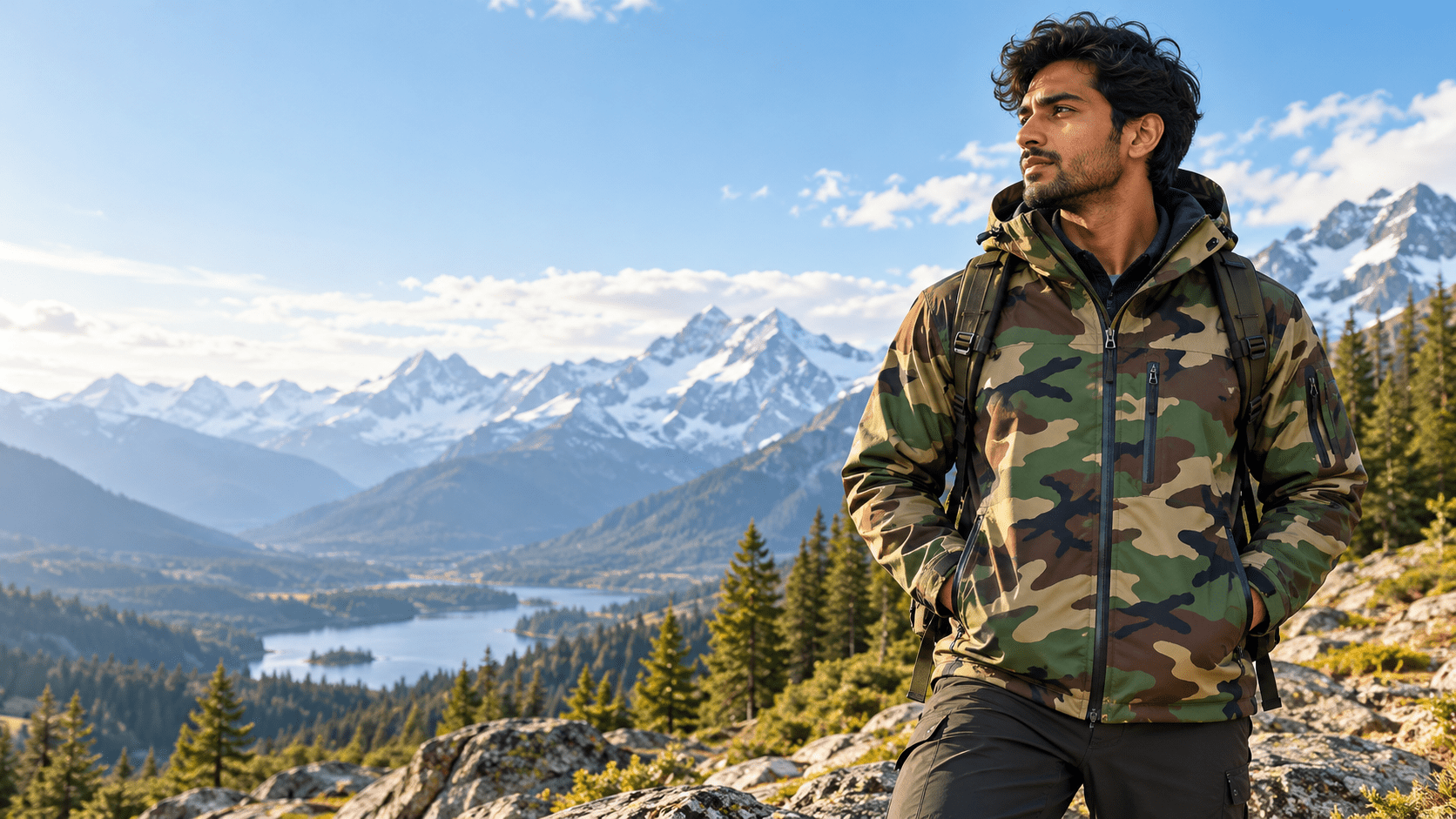
Blog Article
Woodland Jacket: Pattern, Cut and What to Look For
Woodland Jacket: Pattern, Cut and What to Look For
A genuine Woodland print is a specific four-colour, non-pixelated design, not a loose label for any green-brown camouflage. Confirming the print before you buy takes under a minute: look for light green, dark green, brown and black arranged in large organic blotches with no square pixels anywhere in the repeat. Getting the print right is only half the purchase, though, since the same name covers three very different jacket constructions, a field jacket, a softshell and a lightweight shell, each suited to a different Indian condition. Checking print, construction and fit together before you buy takes about ten minutes and avoids the two most common disappointments in this category: a jacket that isn't actually Woodland, and a Woodland jacket built for the wrong weather.
How do you tell genuine Woodland from an adjacent pattern?
Sellers use "woodland" loosely, and several genuinely distinct designs get sold under the same word. Checking structure, not just colour, separates them.
| What the seller calls it | What to look for | Relationship to Woodland |
|---|---|---|
| U.S./M81 Woodland | Four colours, broad smooth-edged organic masses, a conspicuous black branching form | The genuine large-scale design; colour alone does not confirm it |
| ERDL / leaf pattern | Similar organic geometry but a visibly smaller scale | The direct predecessor design, not the same specification |
| CADPAT Temperate Woodland | Dense field of small square pixels | A separate Canadian digital design; "woodland" here names a colourway, not the M81 structure |
| MARPAT Woodland | Pixelated texture in small digital blocks | A separate digital family; pixelation alone rules out genuine Woodland |
| Tiger stripe | Predominantly horizontal narrow bands | Structurally unrelated; horizontal banding is not Woodland's organic-blotch structure |
| Generic green camouflage | Any olive, khaki, brown and black mixture without the Woodland repeat | A retail category, not a controlled design |
| Urban, blue or bright recoloured "Woodland" | The familiar organic template recoloured outside the green-brown palette | A commercial fashion recolour, not a terrain variant |
A pixelated design is not automatically more advanced, and a smooth-edged design is not automatically genuine Woodland unless the geometry, scale and four-colour relationship all correspond. Ask a seller directly whether a listing is "M81 Woodland," "Woodland-style" or simply "Woodland-inspired," since only the first claims a real link to the original design, and a straight answer here tells you more than the product photo does.
What do the four colours actually look like on fabric?
Woodland's palette runs Light Green, Dark Green, Brown and Black, arranged hierarchically: broad rounded green and brown masses form the main shapes, and narrower black forms cut across them for the sharpest contrast. The original US military specification for this cloth is documented in MIL-C-44031, which covers camouflage-pattern cotton and nylon cloth printed to the design. Screen colour charts and hex-code palettes claiming to reproduce these shades online conflict with each other and should not be used to authenticate a physical garment; the only reliable check is the fabric itself under neutral daylight.
A mismatched motif across an ordinary side seam is not automatically a manufacturing defect. Woodland's large repeat means panels are cut and sewn without matching the print like wallpaper, so random joins at seams are inherent to normal production, not evidence of a cheap print.
How do you check print quality before you buy?
Registration, meaning whether each colour lands in its intended position, is the single most reliable print-quality check available to a buyer without lab equipment. Inspect the boundaries where black meets green, green meets brown, and brown meets the light ground.
- Good: boundaries are deliberate and similarly sharp throughout the garment, and any small planned overlap is consistent panel to panel.
- Poor: pale slivers between colours, doubled edges, coloured halos, black shifted off its intended branch shape, or a colour missing from part of the repeat.
- Not a defect: the motif failing to continue across a pocket or seam. That is a consequence of how the fabric is cut, not a quality signal.
Compare sleeves, hood, pocket flaps and torso against each other in neutral daylight. All panels should carry a coherent tonal balance; one panel reading grey-green while another reads yellow-green, with no intentional colour-blocking, points to a batch or dye-lot inconsistency worth rejecting over. textile print-defect research identifies mottling, pinholes, streaking and uneven density as the standard markers of poor ink coverage, separate from registration errors, and both are worth checking on a physical garment before you buy rather than trusting a product photo alone.
For fastness, ask whether the seller can name a test method rather than accepting "colourfast" as an unsupported adjective. A practical shop-floor check: rub a hidden black or brown area with a clean, barely damp white cloth. Visible colour transfer suggests poor dye fixation, though this test cannot replace a proper lab report and only catches the worst cases.
Why does a Woodland print fade unevenly rather than all at once?
A four-colour print is chemically four separate colour systems on one fabric, and cotton and nylon in a blend accept dye differently, so light, detergent, sweat and abrasion do not necessarily change every colour at the same rate. Cuffs, elbows, pocket edges and shoulders under a backpack strap take more rubbing and lose surface colourant faster than protected areas like the inside of a hood. Folds, seam ridges and pocket flaps also receive unequal light and friction over time, which is why a stored hood or a covered pocket flap can develop a visible shade difference against the rest of the jacket well before the garment shows general wear.
None of this means a print quality issue and normal wear look the same. Severe first-wash bleeding, strong colour transfer on a rub test, or rapid divergence between panels within the first few wears point to poor dye fixation, not to the ordinary uneven fading every printed camouflage eventually shows.
Which jacket construction should you actually buy?
"Woodland jacket" spans three genuinely different builds, and the print tells you nothing about which one you're getting.
| Construction | Typical build | Best civilian use | Main caution |
|---|---|---|---|
| Field jacket | Woven cotton/nylon shell, relaxed cut, multiple patch pockets, storm flap, waist adjustment | Everyday wear, travel, light brush, cool dry conditions | Heavier and slower to dry than a synthetic shell; a DWR finish is not the same as seam-sealed waterproofing |
| Softshell | Stretch woven face, often bonded to fleece, commonly water-resistant rather than waterproof | Cool-weather hiking, cycling and high-movement use when heavy rain is unlikely | A fleece-lined build can run too warm in humid lowland conditions |
| Lightweight or wind shell | Thin nylon or polyester face, low insulation, may be wind-resistant or a seam-sealed waterproof laminate | Packable wind layer, commuting, changeable weather; the seam-sealed version is the right call for sustained monsoon rain | "Water-repellent" and "waterproof" are not interchangeable claims, and DWR beading can decline with wear and need reproofing |
For Western Ghats monsoon trekking, weather management outranks print authenticity: favour a seam-sealed waterproof shell with a protective hood over a field jacket or softshell during sustained rain, and reserve the heavier builds for drier, cooler periods. For Himalayan foothill travel in leafy seasons, a breathable softshell balances movement and light-precipitation protection, while a field jacket suits low-output town use and layering more than active trekking. MountMiller's own range maps directly onto this: the Woodland M65 Field Jacket fills the field-jacket slot, the Woodland DWR Technical Softshell fills the softshell slot, and the Woodland Airshell Windjacket fills the lightweight-shell slot, so match the construction to the condition first and treat the print as the second decision, not the first.
What should you check for fit and construction quality?
Try the jacket over the thickest layer you realistically expect to wear underneath it. Zip it fully, raise both arms, reach forward as if holding handlebars, sit down, and load every pocket you intend to use before deciding on size.
- Straight, balanced front zip and storm flap with no twisting when closed.
- Secure bar tacks or reinforcement at pocket corners, cuff tabs and drawcord exits.
- No skipped stitches, loose chain ends or seam puckering anywhere on the garment.
- For a rain shell specifically, taped or sealed internal seams and a clear waterproof-material specification, since DWR alone only makes surface water bead rather than blocking it.
- For a softshell, enough shoulder and elbow articulation to actually use the fabric's stretch, since mobility and breathability are the category's real value over guaranteed downpour protection.
- For a field jacket, room for a mid-layer underneath and functional waist or hem drawcords, since the category's traditional value is a loose layering cut rather than a close athletic fit.
Check pocket-flap and placket placement from a few metres away as well as up close. Exact motif matching across panels is not required, but a large isolated black form landing squarely on one chest pocket and nowhere else can create a visible asymmetry that a closer inspection misses.
Print placement also changes how the jacket appears to fit, even when the measurements are identical. Because production cuts the repeat randomly across panels, a broad light-green patch centred on the abdomen can draw the eye and make that area look wider, while darker masses near the side panels can visually narrow the torso. Compare the actual unit you're buying, or the retailer's unit-specific photographs, rather than assuming every jacket on one product page places the pattern identically.
Buying checklist for a Woodland jacket
- Confirm four non-pixelated colours in large organic masses with a black branching structure; square pixels mean it isn't M81 Woodland.
- Ask how the seller names it: "M81 Woodland," "Woodland-style" and "Woodland-inspired" are honest; an unsupported claim of exact specification is not.
- Request fibre percentages, construction type, membrane or coating, lining and the care label before you commit.
- Verify weather language specifically: "DWR" and "water-resistant" do not prove a sealed, waterproof construction.
- Inspect registration for shifted colour halos, doubled boundaries, missing colour or streaking.
- Compare sleeve, hood, torso and pocket panels in daylight for a coherent tonal match.
- Choose the jacket class to the condition, field jacket for utility and style, softshell for movement in mostly dry cool weather, sealed lightweight shell for sustained rain, before you choose based on the print alone.
- Test movement fully: zip up, reach, sit, and load the pockets you actually intend to use.
Getting the construction right before the print
A "military grade" claim on the listing settles nothing, and neither does the price tag next to it, since no controlled Indian retail data links either one to registration accuracy or wash fastness in this category. What actually predicts satisfaction is checking registration and panel colour match in daylight, confirming the fibre and membrane facts directly rather than trusting a product photo, and picking the jacket construction, field, softshell or sealed shell, against the specific weather you'll actually wear it in. A Woodland field jacket that looks perfect on a hanger is still the wrong buy for a Western Ghats downpour, and getting that decision right matters more than any authenticity claim printed on the tag. Buyers wanting a heavier layered build for shoulder-season cold can compare that against the Woodland 3 Layer Parkha directly, since a layered construction changes the warmth and weight trade-off from any of the three constructions above.
Frequently asked questions about buying a Woodland jacket
Is a pixelated "digital Woodland" jacket the same as genuine M81 Woodland?
No. Genuine M81 Woodland is a non-pixelated, four-colour organic-blotch design. A pixelated print, whether marketed as CADPAT-style or MARPAT-style, uses a completely different square-pixel structure and belongs to a separate design family, even where the overall green-brown colour impression looks similar from a distance. Pixelation alone rules out genuine Woodland regardless of what the listing calls it.
Does a higher price guarantee better print quality on a Woodland jacket?
No. Without a named fastness test result or a transparent fibre and print-method specification from the seller, price alone does not establish registration accuracy, colour-match consistency or fade resistance. A cheaper jacket with disclosed specifications and a clean registration check can outperform a pricier one sold on branding alone.
Will my Woodland jacket's colours fade evenly over time?
Not necessarily, and uneven fading is not automatically a defect. Cuffs, elbows and shoulder areas under a backpack strap take more abrasion and lose surface colour faster than protected areas like the underside of a hood, since light, detergent and rubbing act on each of the four dye colours differently. Severe first-wash bleeding or rapid divergence between panels in the first few wears is the actual warning sign, not gradual, uneven wear over a season.
Can I wear a softshell Woodland jacket in heavy monsoon rain?
Not reliably. Most softshell construction is water-resistant rather than fully waterproof, prioritising breathability and stretch over sustained precipitation protection. For heavy, sustained monsoon rain, a seam-sealed lightweight or hardshell construction with taped internal seams is the more reliable choice, and a softshell is better reserved for cooler, drier conditions or light, short-duration rain.
How can I check if a Woodland print will hold up in the wash before I buy?
Ask the seller for a named colourfastness test method and grade rather than accepting "fade-proof" as a marketing claim. As a rough shop-floor check, rub a hidden dark area of the fabric with a clean, slightly damp white cloth; visible colour transfer suggests weak dye fixation. This test cannot replace a lab report, but it catches the most obvious problems before you commit to a purchase.

Comments
Leave a comment
Your email address will not be published. Required fields are marked *
No comments yet. Be the first to share your thoughts!