


Cart
0

Blog Article
Knee Pads and Technical Caps: The Accessories Guide
Knee Pads and Technical Caps: The Accessories Guide
A good knee pad matches the hazard, not the price tag: a hard or hybrid face for abrasion and sharp debris, certified impact foam for cycling falls, and broad pressure-spreading foam or gel for repeated kneeling. A good technical cap matches exposure the same way, moisture handling and full ear coverage for active cold, a wind-blocking layer for open ridges, verified UV-blocking fabric paired with real brim coverage for Indian sun. Neither category has a single best construction. Matching the spec to what you actually do with it takes about ten minutes of checking the listing properly.
What do the knee-pad terms on a listing actually mean?
"Hard," "soft," "gel" and "hinged" describe construction. They do not, by themselves, describe protection level.
| Listing term | What it should mean | Where it commonly falls short |
|---|---|---|
| Hard-shell cap | Rigid or semi-rigid plastic/rubber face over cushioning | Bulky and hot in motion; a rigid shell alone does not prove impact or puncture performance |
| Soft foam pad | Flexible cushioning, often in a sleeve | Foam can bottom out under prolonged load; less abrasion shielding unless separately reinforced |
| Gel pad | A gel insert, usually combined with foam | Heavier and warmer; "gel" is a material description, not a certification |
| Hinged/articulated | Upper and lower sections move with knee flexion | More components, bulk and possible snag points; articulation alone does not establish protection level |
| Trouser-pocket insert | Pad located in a purpose-made knee pocket | The pocket must actually hold the pad over the knee; a loose insert should not inherit another trouser's rating |
Construction words and certification are two different claims. A hard cap with no named standard and level is not equivalent to a certified protector, whatever the listing photo suggests.
How is knee protection actually certified?
Two certification families cover almost everything sold as a "protective" knee pad in India, and confusing them is the single most common buying mistake in this category.
Work-kneeling protection runs under EN 14404:2024, split into wearable Type 1 protectors, Type 2 pad-and-garment combinations, Type 3 knee mats and Type 4 kneeling systems. Within those types, a penetration level of 0 through 2 describes how much puncture force the pad resists on flat or uneven surfaces, not how it performs in a fall. A genuine EU work-protection marking shows the CE mark, the EN 14404 reference, and the specific Type/Part and level, backed by a Declaration of Conformity.
Sport-impact protection runs under EN 1621-1:2012 for motorcycle limb-joint protectors, which cycling-pad makers also commonly claim. It tests transmitted force under a fall, with Level 1 at up to 35 kN and Level 2 at up to 20 kN, lower transmitted force being the more protective result. A separate standard, EN 14120, covers roller-sport protectors like skating and skateboarding pads, and uses its own Level 1/2 scale based on body mass rather than transmitted force.
These three "Level 1/2" systems are not interchangeable. EN 14404 Level 2 means work-kneeling penetration performance. EN 1621-1 Level 2 means lower transmitted impact force for motorcycle-class limb armour. EN 14120 Level 2 means the higher roller-sport class. A pad labelled only "Level 2" with no standard number attached is telling you nothing verifiable. No India-specific BIS standard for knee pads was located in BIS's own product-certification pages, so an unexplained "ISI" or "industrial grade" claim on a knee pad should be treated as unverified until the seller names the exact standard and licence.
Which knee pad fits your actual use case?
| Use case | Best-matched construction | Main limitation |
|---|---|---|
| Ordinary trekking descent | Usually no pad; trekking poles and controlled steps instead | Pads do not unload the joint during every step the way poles do |
| Trekking with scrambling on rock | Low-profile flexible sleeve or hybrid pad | Not a substitute for poles; soft sleeves offer limited sharp-rock resistance unless reinforced |
| Road or commuter cycling | Thin, pedal-friendly flexible pad, only where fall risk justifies it | Sweat and repetitive flexion in Indian heat magnify chafing and migration |
| Trail/MTB, long pedalling | Flexible soft-shell or hybrid sleeve with secure upper retention | Less coverage than heavier gravity-riding designs |
| Downhill, enduro or high-consequence MTB | Larger certified protector with strong straps or cuffs | Greater heat and bulk; cannot prevent twisting injuries |
| Trade work on concrete, rubble or roofing | Hard or semi-rigid cap over substantial foam, EN 14404 Type 1 Level 1U or 2 | Can mark finished floors; straps and retained heat add discomfort over a full shift |
A knee pad addresses direct contact, impact and penetration. It is not a substitute for an orthopaedic compression sleeve or patellar brace, and it does not treat joint pain. A trekking-pole descent study found poles measurably reduced the forces and moments at the knee joint during descent, which is a mechanism no surface pad reproduces, since a pad cannot unload the joint the way a pole redistributing weight through the arms can.
How should you check attachment and sizing before you buy?
Slippage and circulation complaints trace almost entirely to fit, not to foam quality.
There is no universal S/M/L conversion for knee pads. Cycling-pad charts commonly ask for thigh and calf circumference measured at a fixed distance above and below the kneecap centre, and that distance varies by brand, which is why the maker's own measurement diagram has to control your sizing decision rather than a generic chart. Measure on bare skin in the posture the maker specifies, compare both circumferences against the chart, and try the pad with the actual shorts or trousers you plan to wear it under. Walk, climb stairs, squat and kneel for ten to twenty minutes before deciding a fit works. Reject a pad that exposes the kneecap, rotates during movement, pinches behind the knee, or needs circulation-cutting tension just to stay in place.
Watch for these specific attachment failures:
- Single elastic strap: few anchor points, tends to rotate or drop unless tightened hard enough to restrict circulation.
- Straps crossing the popliteal crease (the fold behind the knee): a common cause of numbness and tingling, and a design flaw worth rejecting rather than working around.
- Compression sleeve with silicone gripper: retains well when correctly sized to both thigh and calf, but migrates when sweaty or mismatched to your leg shape. OSHA's shipyard ergonomics guidance is explicit that a knee pad should fit snugly without compromising lower-leg circulation, and should be replaced once the cushioning compacts rather than tightened further to compensate.
Stop and loosen or remove any pad that produces numbness, tingling, colour change, coldness or deep persistent strap marks. None of those are signs of a secure fit.
What actually determines whether technical headwear performs?
Fibre name alone does not set a temperature rating. Warmth depends on fabric mass, loft, knit density, lining, wind permeability, wetness, activity level and how much of the head and ears the piece actually covers.
| Material | Moisture behaviour | Best Indian use | Failure mode to expect |
|---|---|---|---|
| Merino wool | Absorbs and transports vapour; resists odour; dries slower than synthetics when saturated | Multi-day Himalayan trekking, odour-sensitive travel | Higher price, care needs, occasional itch sensitivity |
| Acrylic knit | Low moisture regain (roughly 1.5-2%); holds little vapour but can trap liquid sweat | Dry, low-output city winter | Clamminess under exertion, static, pilling |
| Polyester fleece | Breathable, wicking, fast-drying per manufacturer technical literature | Active cold, damp shoulder-season conditions | Not automatically windproof; thick fleece overheats under exertion |
| Fleece-lined knit | Adds loft; liner wicks but whole-hat drying depends on outer openness | Stationary cold, high-altitude evenings | Bulk under helmets; some versions run hot even below freezing |
| Wind-membrane ear panel | Blocks convective heat loss without adding much loft | Exposed ridges, winter cycling | Less breathable than open knit; can create audible rustle |
For high-output trekking or cycling, choose a thin, close-fitting cap that reaches below the ear tops without changing how a helmet sits. For windy ridges, add a genuinely wind-resistant ear panel rather than just more fleece thickness, since more insulation does not stop wind passing through an open knit. For stationary cold or camp use, full ear coverage and fleece lining earn their bulk because metabolic heat output is lower.
How do you verify a sun-protective claim?
UPF is a fabric-level ultraviolet-protection rating, not sunscreen SPF, and it is not a guarantee that a hat shades your whole face. Under the relevant Australian/New Zealand testing standard, UPF 15 is minimum protection, UPF 30 is good, and UPF 50 or above is excellent, measured on the material itself under controlled conditions.
| Feature | What good looks like | Why it matters |
|---|---|---|
| Verified fabric UPF | A UPF value plus a named test standard, not just the word "UV-protective" | The rating applies to the tested material and colour, not any hat claiming the same fabric family |
| Brim geometry | Down-angled, stable brim, commonly at least 7.5cm on an adult broad-brim hat | A broad brim protects nose, cheeks, ears and neck; a baseball cap peak does not |
| Ventilation | Small protected eyelets or a UPF-rated mesh crown | Large untested mesh panels improve airflow but can create UV gaps |
For exposed trekking, fieldwork or all-day sightseeing in strong Indian sun, a stable broad-brim or legionnaire-style hat covers more skin than a sports cap does. A cap works for running or cycling where visibility and airflow matter more, but sunscreen still has to cover the ears, cheeks and neck that the cap leaves open. Cancer Council sun-clothing guidance makes the same point about clothing coverage generally: a high UPF rating on the covered area says nothing about the skin the garment does not cover.
Where do the most common complaints actually come from?
Design, not bad luck, explains almost every recurring complaint in this category.
| Complaint | Likely design cause | Buying check |
|---|---|---|
| Knee pad slides down while walking or pedalling | Wrong thigh-to-calf taper, fatigued elastic, sweat-reduced grip | Match both circumferences to the maker's chart; do a sweaty-movement test before committing |
| Numbness or tingling below the pad | Straps overtightened to compensate for poor shape | Reject the model; do not tighten further |
| Cap or beanie leaves ears cold | Shallow cut, cuff rides up, no wind barrier | Verify depth in centimetres and full ear coverage, not just "warm" in the description |
| Good airflow but scalp burns | Large mesh panel without its own UPF rating | Confirm the UPF claim covers the mesh and crown, not only the solid panels |
| Brim flops into eyes in rain or wind | Very soft, unreinforced brim edge | Check for a stiffened or wired brim edge if you expect monsoon or windy use |
What should the price tell you, and what should it not?
Price is a market filter, not proof of protection. A basic foam sport knee pad, a certified work pad and an imported sport-impact protector can all sit in overlapping price bands while carrying entirely different certifications, which means price alone cannot substitute for checking the standard and level printed on the listing. The same applies to headwear: a ₹200 winter beanie and a ₹1,000 technical trekking hat may both be honestly priced for what they are, but only the fabric percentages, lining extent and stated test standard tell you which one does what you need. Spend on verifiable function first: named standard and level for a knee pad, fibre percentages and ear coverage for cold-weather headwear, named UPF standard and brim geometry for sun headwear, and only then let price break the tie between two specs that already match your use case.
Buying accessories that actually do the job you need
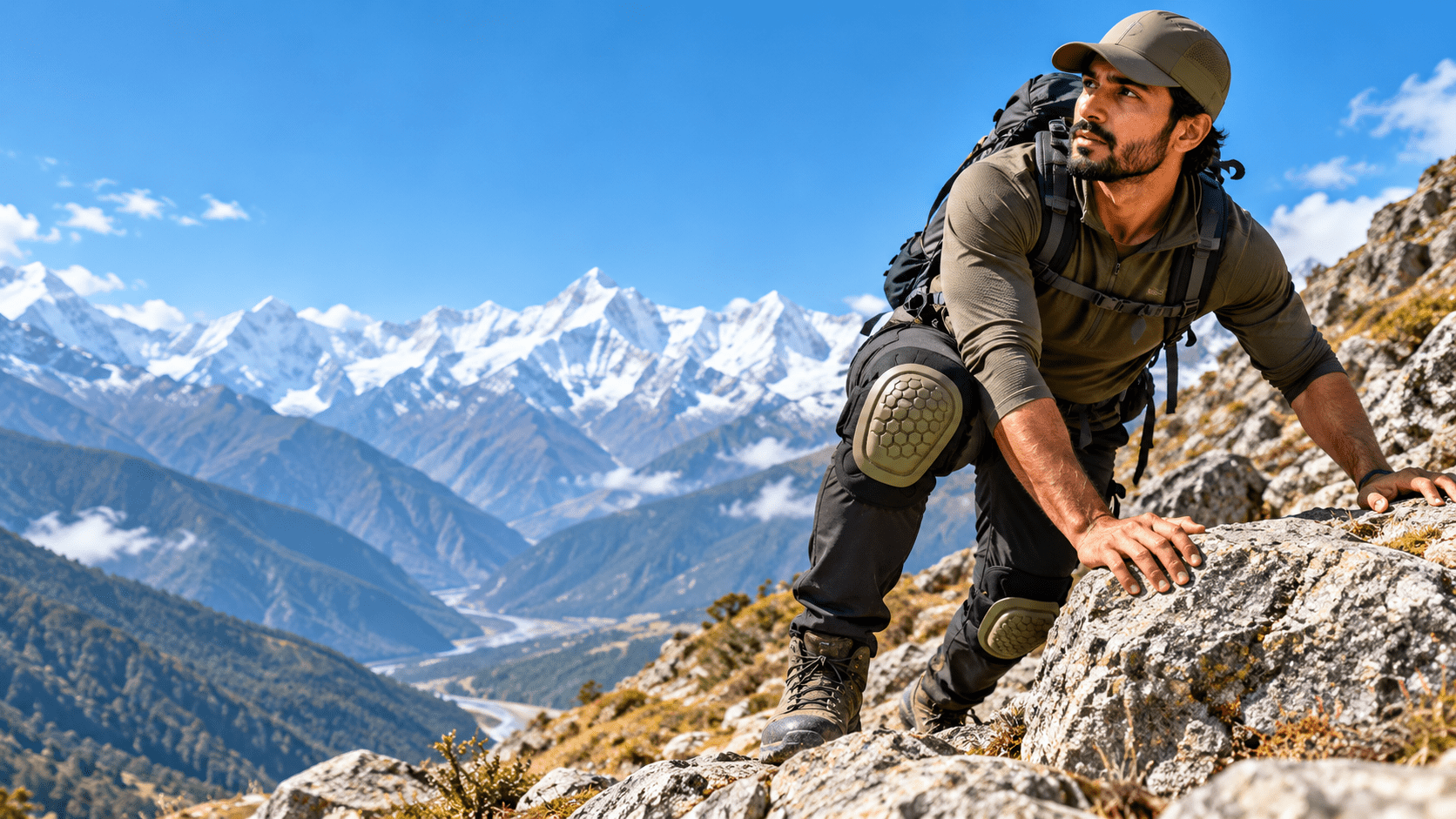
Zero accessory content exists for most Indian tactical and outdoor buyers right now, which is exactly why this category gets bought on price and packaging instead of on spec. A Black Knee Pads pair works for trade-style kneeling and rougher trail contact where the hard-cap-over-foam construction covers both penetration and abrasion, while a Khaki Knee Pads set suits lighter scrambling where colour matching to trekking kit matters more than maximum shell rigidity. For headwear, the Black Vinson Winter Cap is built for the active-cold end of the table above rather than stationary camp use, so check ear depth against your actual conditions before assuming any winter cap covers what you need. Whatever you're buying in this category, the listing should answer the certification, sizing and coverage questions above before price enters the decision at all.
Frequently asked questions about knee pads and technical headwear
Do I need a certified knee pad for ordinary trekking?
Usually not. For ordinary descents, trekking poles and controlled steps address the repetitive joint load better than a surface pad can, since poles reduce the forces transmitted through the knee rather than just cushioning contact. A pad becomes worth considering when scrambling or frequent kneeling on rock adds real fall or abrasion risk, not as a default addition to every trek.
Can I use a motorcycle-rated knee pad for mountain biking?
Often, yes, with a caveat. EN 1621-1's formal scope is motorcycle limb-joint protectors, but cycling-pad makers commonly certify bicycle knee pads to the same standard, and the impact-attenuation result is meaningful either way. Treat the EN 1621-1 level as a genuine impact-protection indicator, not as an abrasion-complete or bicycle-specific rating on its own.
Why does my knee pad feel fine standing still but slip during a ride?
Static fit and dynamic fit are different tests. A pad can sit correctly while you stand but migrate once sweat, muscle flexion and pedalling motion change the thigh-to-calf relationship it was measured against. Always test a pad through ten to twenty minutes of the actual movement you'll use it for, not just a standing try-on, before deciding the size is right.
Is a higher UPF rating always better for Indian sun?
Not automatically. UPF 50 blocks more ultraviolet than UPF 30 on the tested fabric itself, but a UPF 50 crown with a short brim or no ear coverage still leaves your face and neck exposed. Brim geometry and ear coverage matter as much as the fabric number, since the rating only protects the skin the garment actually covers.
Does a thicker beanie always mean a warmer one?
No. Warmth depends on fabric mass, loft, knit density and how completely the beanie covers the ears, not thickness alone. A thin merino or synthetic skull cap with full ear coverage can outperform a thick acrylic beanie that rides up during activity, particularly once sweat is factored into the comparison.


Comments
Leave a comment
Your email address will not be published. Required fields are marked *
No comments yet. Be the first to share your thoughts!