


Cart
0

Blog Article
Windproof Jackets for Winter Mornings and Two-Wheeler Commutes
Windproof Jackets for Winter Mornings and Two-Wheeler Commutes
A cold early-morning ride on a scooter or motorcycle finds every gap in a jacket. The words on the label, "windproof", "air proof" or "wind shield", matter less than two things you can check: evidence that the fabric lets little air through, and closures that seal the neck, wrists, waist and front zip when you sit forward on the vehicle. The guide below covers everyday jackets for two-wheeler commuting and early-morning walks, not impact-protective riding gear. It covers label terms, weighted criteria, constructions, seated fit checks and price bands, so you can judge a listing before you pay.
Do you need a windproof jacket or a warmer one?
You need a windproof layer if you feel warm standing still but cold once the vehicle starts moving; you need more warmth if you feel cold even in still air. Wind blocking and warmth are separate requirements. A wind-blocking outer layer protects the warm air your clothing holds underneath, while NOAA's cold-weather guidance still recommends adjustable layers rather than one heavy garment.
Three situations point to three different purchases:
- Warm while standing, cold only once moving: check the jacket you already own for wind leakage before buying more bulk.
- Cold even without moving air: assess the warmth of the whole outfit, because "windproof" on its own says nothing about warmth.
- Walking briskly and getting damp inside: look at ventilation and water-vapour performance, since a stronger wind barrier on its own may not solve it.
How much colder does a two-wheeler ride feel in winter wind?
Faster air makes the same temperature feel colder on exposed skin. At 5°C, the wind-chill index gives about 1°C with a 20 km/h wind and about -2°C with a 60 km/h wind. The US National Weather Service bases wind chill on heat loss from an exposed human face, so the index describes bare skin rather than conditions inside a jacket. The index applies only at or below 10°C with wind above about 4.8 km/h, so it gives no meaningful figure for a 15°C or 20°C morning.
The table shows rounded index results from Environment Canada's wind-chill calculator, the model that US and Canadian weather agencies use:
| Air temperature | 20 km/h wind | 40 km/h wind | 60 km/h wind |
|---|---|---|---|
| 10°C | About 7°C | About 6°C | About 5°C |
| 5°C | About 1°C | About -1°C | About -2°C |
| 0°C | About -5°C | About -7°C | About -9°C |

Take a 5°C morning ride at 40 km/h as an illustration. If you enter road speed as the wind input, the index gives about -1°C, 6 degrees below the air temperature, for skin left exposed at the neck and wrists. Treat that as a rough approximation: the index's assumptions about wind height and an exposed face do not model a particular scooter, windscreen, helmet, riding posture or jacket. The figure still shows why gaps at the collar and cuffs matter on a moving vehicle.
What do "windproof", "air proof" and "wind shield" mean on a jacket label?
"Windproof" claims that very little air passes through the fabric under specified test conditions; "air proof", "wind shield" and "windcheater" are shopping terms that the air-permeability test methods do not define. Use the shopping terms to find products, then judge the specification behind them.
| Label | What it means technically | How to shop with it |
|---|---|---|
| Windproof (wind proof) | Very little air passes through under specified testing; not necessarily zero airflow | Ask which test, result and pressure support the claim |
| Wind-resistant | Resists airflow, with no numerical level attached to the words | Weaker evidence than a documented low-permeability result |
| Air proof, wind shield, windcheater | Shopping terms, not performance classes in the air-permeability test methods | Use them to search, then read the specification |
| Water-repellent | Water beads off the outer fabric because of a durable water repellent (DWR) treatment; says nothing about airflow | Do not accept water beading as proof of wind blocking |
Indian listings show the gap between claim and evidence. One branded windbreaker page promises protection against wind chill and lists its fabric and closures, and another claims wind resistance, but neither publishes an air-permeability result. A beading demonstration in a shop shows the water-repellent finish at work, yet it measures nothing about wind.
What should you look for in a windproof commuting jacket?
Look first for air-permeability evidence and for closures that seal the gaps, then for panel coverage, ventilation, layering room and visibility. The weights below change with use: on a relatively inactive commute, a continuous wind barrier matters most, while on an active morning walk, ventilation and moisture handling rise in importance.
| Criterion | Weight on a commute | Weight on a brisk walk | What to check |
|---|---|---|---|
| Air-permeability evidence | High | Medium | A result with its unit, test method and test pressure |
| Closures at neck, wrists, waist and zip | High | Medium | High collar, closable cuffs, adjustable or dropped hem, front-zip storm flap |
| Panel coverage | High | Medium | Whether sides, underarms and back use the same fabric as the front |
| Ventilation and vapour transfer | Low | High | Front zip and vents you can open; a breathable construction |
| Layering room | Medium | Medium | Space for your usual sweater when you reach forward |
| Visibility before sunrise | High if you ride in the dark | Low | Reflective details visible from the front, sides and rear |
A poor fit on a high-weight criterion, such as a short back or a cuff that will not close, rules a jacket out whatever its fabric claim. A missing permeability figure works differently: it leaves the windproof claim unconfirmed rather than proving the jacket fails.
How do you read an air-permeability figure?
Read it as four parts: the result, its unit, the test method and the test pressure. A lower result means a stronger wind barrier only when the tests ran under comparable conditions.
Air-permeability testing measures how much air passes through a known area of fabric while the tester holds a set pressure difference across it.
The two common methods report differently:
| Method | How it reports | Default conditions |
|---|---|---|
| ISO 9237:1995 | mm/s | Recommends a 20 cm² test area and a 100 Pa pressure difference for apparel, with agreed alternatives allowed |
| ASTM D737 | cm³/s/cm² or ft³/min/ft² | The 2016 edition specifies 125 Pa when no other pressure is agreed; BSI lists D737-18(2023) as the current edition |
The units convert, but the conversion does not make every pair of results comparable:
- mm/s and L/m²/s measure the same thing, air volume per fabric area per second, and 1 ft³/min/ft² equals about 5.08 L/m²/s. Results taken at different pressures still cannot be compared directly.
- "CFM" is common shorthand for ft³/min/ft². A bare CFM figure, without the area, is incomplete for comparing fabrics.
Neither ISO 9237 nor ASTM D737 sets a retail pass mark for "windproof". Gore, the membrane maker, publishes its own windproof criterion: air permeability of 1.0 cfm or less, alongside the rounded figure of under 5 L/m²/s. Using the conversion above, 1.0 cfm works out to about 5.08 L/m²/s, which Gore rounds to "under 5". The criterion belongs to Gore rather than to any standard, and its public page does not state the test pressure beside it.
How do woven, membrane and coated windshells compare?
All three constructions limit airflow, and each gives up some ventilation in exchange; none suits every use. The labels also overlap: a membrane bonded to fabric makes a laminate, and a tightly woven fabric can also have a coating.
| Construction | How it limits airflow | Breathability trade-off |
|---|---|---|
| Tightly woven windshell | A dense weave leaves fewer open pathways for air; calendering, which flattens the fabric, can cut permeability further | Weave and finish matter more than the word "nylon" or "polyester"; making airflow harder also reduces ventilation through the fabric |
| Membrane laminate | A thin barrier bonded to the textile stops bulk airflow; some membranes are microporous, others poreless and moisture-transporting | Can block wind while passing water vapour, within physical limits that depend on conditions |
| Coated fabric | A coating on the textile, such as a microporous coating on a tightly woven face fabric, modifies the barrier | "Coated" does not automatically mean non-breathable, though the label gives no moisture-transfer number |
Air permeability and water-vapour breathability are different measurements. ISO 9237 measures airflow, while ISO 11092 measures thermal and water-vapour resistance on a sweating heated plate. A jacket can score well on one and poorly on the other, so ask for both figures if you will walk hard in the jacket as well as ride.
Which fit details keep wind out when you sit on a two-wheeler?
Check the back hem, collar, cuffs, front-zip flap, adjustable hem, layering room and panel coverage while seated and reaching forward, over the sweater you actually commute in, because a jacket that fits well standing can open gaps on the vehicle.
| Detail | What to check while seated and reaching forward |
|---|---|
| Dropped back hem | The back still overlaps your trousers when you reach for the handlebars |
| High collar | It closes around the throat without a large gap, and without pressure that tempts you to leave it open |
| Closable cuffs | Elastic, hook-and-loop tabs or another closure fits your wrists and overlaps your gloves |
| Front-zip storm flap | A continuous flap behind or over the zip, not only a small chin guard at the top |
| Adjustable hem | It closes around your waist without pulling the back upward |
| Layering room | Your usual sweater fits underneath without the chest, shoulders or sleeves restricting you |
| Panel coverage | Sides, underarms and back, as well as the chest fabric |
Panel coverage matters because some jackets deliberately pair windproof front and arm fabric with more breathable back or underarm panels, so a "windproof" description does not always mean identical wind blocking everywhere. Makers' specifications link elastic cuffs and an adjustable hem to keeping out cold, and a drop-tail hem to extra cover against wind, though none of these specifications puts a number on the warmth gained.
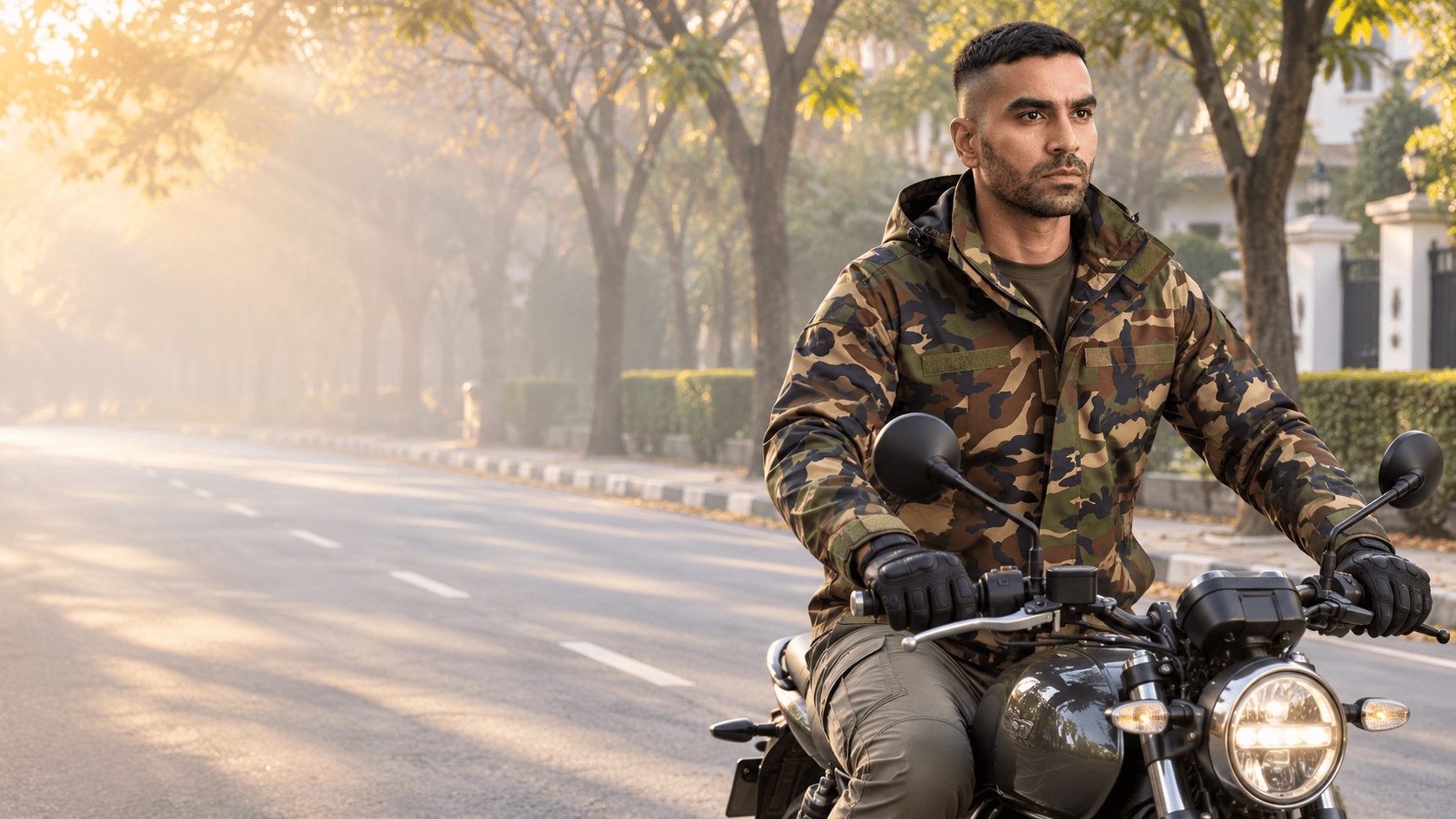
MountMiller's Woodland Airshell WP Windjacket shows these closures on a commuting shell: an adjustable hood, elastic cuffs and a drawstring hem, plus underarm zips for venting on a brisk walk.
How much should a windproof jacket cost in India?
Listed Indian prices for wind jackets range from ₹999 to ₹5,499 across the examples below, and the bands are budgets rather than quality tiers. A higher price neither proves nor disproves better wind blocking.
| Budget band | Listed examples (late October 2026) | What to prioritise |
|---|---|---|
| Up to ₹1,500 | A rain and wind jacket at ₹999; a running windbreaker at ₹1,299 | Fit, openings, panel coverage and return terms |
| ₹1,500-₹3,500 | MountMiller's Woodland Airshell WP Windjacket at ₹2,999 (selling price); a branded windbreaker at ₹2,749 with elastic cuffs and hem | Whether the extra spend buys documented performance or useful fit details |
| ₹3,500-₹6,000 | A windbreaker page showing ₹3,999 and ₹5,499 figures | Test evidence rather than a technology name |
In the ₹1,500-₹3,500 band, the Woodland Airshell WP Windjacket gives a two-wheeler commuter a compact, foldable shell of windproof nylon with a water-repellent DWR finish, sized S to 2XL. Whatever the price, put these questions to the seller before you pay:
- Ask for the air permeability: the result, the unit, the test method, the pressure and which fabric panels were tested.
- Separate claims from evidence. "Windproof" without a result is a claim, and a method name without a result is still incomplete.
- Inspect front, back and interior photographs for the fit details above, and treat missing photographs as an open question rather than proof of a defect.
Frequently asked questions about windproof commuting jackets
Does a negative wind-chill figure mean the jacket is below freezing?
A negative wind-chill figure describes how fast exposed skin loses heat. The Hong Kong Observatory notes that the wind-chill effect describes human heat loss, so a -2°C index reading on a 5°C morning does not mean the air, the fabric or anything inside the jacket has cooled below 5°C.
Does a reflective logo make a jacket visible enough for a pre-dawn ride?
A small reflective logo does not on its own guarantee visibility, and a listing can mention one without publishing any visibility test. UK road-safety guidance for two-wheeler riders separates fluorescent clothing for daylight from reflective clothing or strips in the dark, and warns that drivers may still fail to see a rider. Check that reflective details stay visible from the front, sides and rear with your backpack on.
Can you check windproofing in a shop with a fan or by blowing through the fabric?
A fan or a breath through the fabric can show an obvious draft, but neither check certifies windproofing. Laboratory tests control the pressure, the test area, how the fabric is mounted and air leakage around it, which an informal shop check cannot match. Use a shop check to rule a jacket out, and ask for the permeability result to rule it in.
Is a packable shell better than one warm jacket for a cold-morning, mild-afternoon commute?
A removable, packable shell suits a commute that starts cold and ends mild, because you can adjust a shell as conditions change and some jackets fold into their own pocket. If the return trip is equally cold, compare that shell-over-sweater set-up with a single integrated jacket. The deciding question is whether you will want to take a layer off during the day.

Comments
Leave a comment
Your email address will not be published. Required fields are marked *
No comments yet. Be the first to share your thoughts!