


Cart
0

Blog Article
Trekking Pants for India: How to Choose (and What Most Guides Get Wrong)
Trekking Pants for India: How to Choose (and What Most Guides Get Wrong)
To choose trekking pants for Indian terrain, match the fabric to the season and the construction to your pack, then check that the pant is breathable rather than waterproof. Most buying advice stops at "avoid cotton" and skips the part that matters, which is that fully waterproof trousers are the wrong choice for active trekking in almost every Indian condition. Getting fabric, water treatment, cut, and leg format right takes about twenty minutes of checking specifications before you buy.
What should you check before buying?
Four specifications decide whether a trekking pant will work, and all four appear on a well-written product page. Checking them takes less time than reading a review.
- Fabric composition by percentage. Look for polyamide, polyester, or a blend of either with elastane. A composition listing cotton above a token percentage rules the garment out for sustained walking.
- Stated garment weight. Indian trekking guidance puts the practical ceiling around 150 grams, and a pant well above that becomes a burden you notice by the third day.
- Water treatment, named explicitly. A durable water repellent finish and a laminated waterproof membrane are different things, and the product page should say which one you are buying.
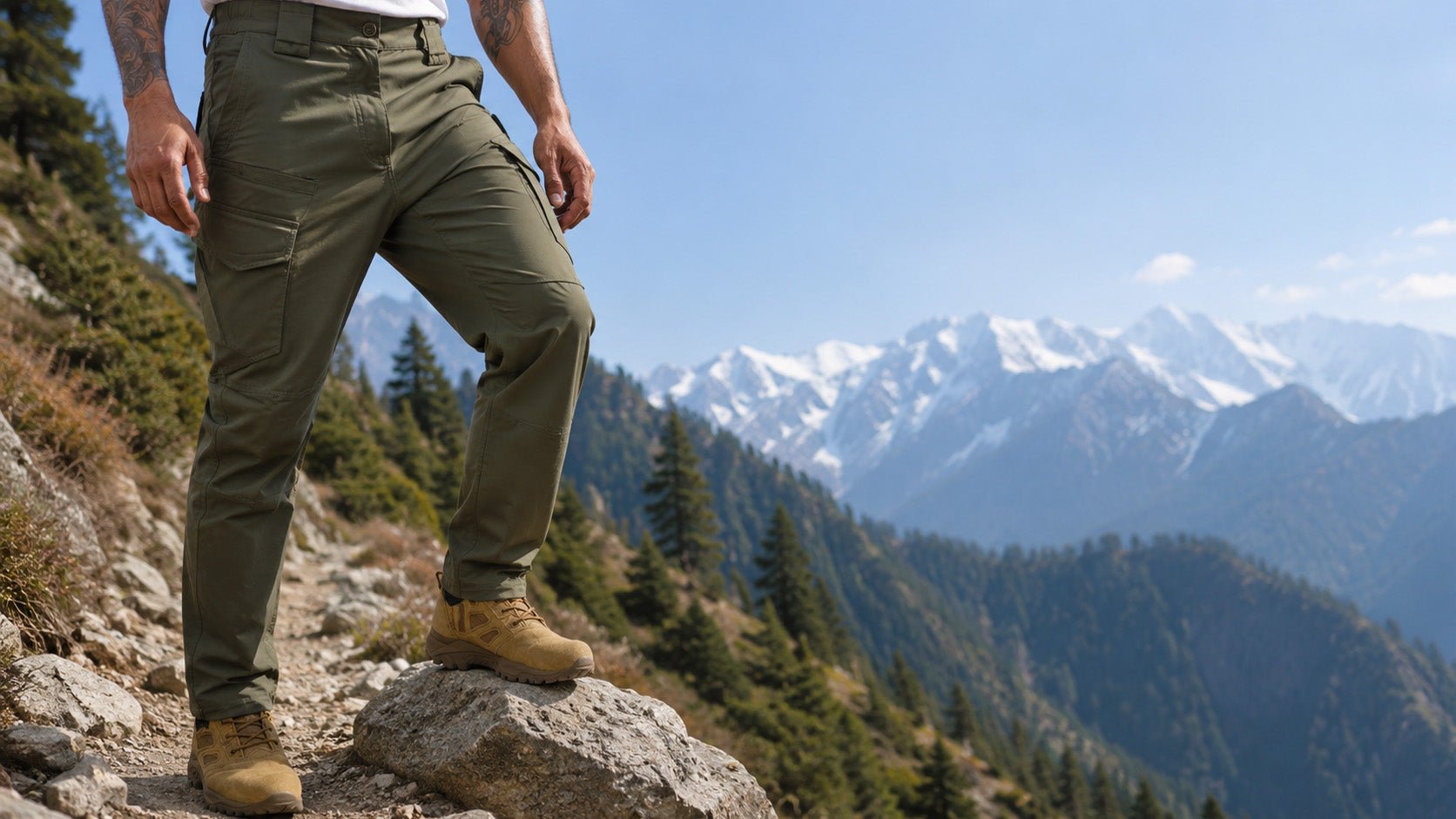
- Gusset and knee articulation. These are visible in product photography if you know to look, and their absence is the most common reason a technically good fabric still binds on a high step.
Sizing needs separate attention. Indian buyers report length and fit inconsistency between brands and even within a single labelled size, so check the brand's own measurement chart in centimetres rather than assuming your jeans size transfers. If you plan to wear thermals underneath at altitude, buy for that layer rather than to a close fit.
What actually goes wrong when you trek in cotton?
Cotton fails on a trail because of how it handles water, not because of how it looks or how heavy it is. Cotton fibres are hygroscopic, meaning they absorb moisture into the fibre structure itself rather than moving it outward to the surface where it can evaporate. Once saturated, the fibre structure collapses and loses the trapped air pockets that provide insulation, and the fabric holds that moisture against your skin.
The cooling effect this produces is the whole problem. Evaporation cools by drawing energy from body heat to turn liquid water into vapour, which is genuinely useful during hard uphill effort and dangerous the moment you stop moving. Controlled testing with a dynamic sweating hot plate has shown that cotton absorbs more latent heat during the drying phase specifically, producing a chilling effect once activity ends, while high-wicking polyester delivers more of its evaporative cooling during active sweating when cooling actually helps.
There is direct clinical evidence for this on the human side too. A randomised pilot study on lightweight outdoor clothing found that at low exercise intensity in cold conditions, a combination of synthetic cap, windbreaker, and pants was necessary to maintain core temperature above a pre-hypothermic threshold, while at high intensity the exercise alone was enough. Slow, exposed walking is precisely what most trekking consists of, which is where clothing choice carries the most weight.
Which fabric should you choose for Indian trekking?
Nylon and polyester dominate technical trekking pants, and the difference between them comes down to how each fibre relates to water at the molecular level. Nylon forms hydrogen-bonding sites with water and holds a few percent of its weight in moisture. Polyester does not form those bonds and holds a small fraction of that. Polyester therefore dries faster, and nylon compensates with noticeably better abrasion resistance against rock and scree.
Elastane appears in small percentages, usually well under ten percent of a woven trekking pant, and its job is shape recovery rather than raw stretch. A pant with poor recovery bags at the knees and seat after a multi-day trek, which is a different failure from a tear and a more common one. Woven trekking pants use light two-way stretch rather than the heavy four-way stretch found in running tights, because more elastane costs abrasion resistance.
| Property | Nylon | Polyester |
|---|---|---|
| Moisture absorbed into fibre | A few percent of weight | A small fraction of nylon's |
| Relative drying speed | Slower | Faster |
| Abrasion resistance | Higher | Moderate |
| UV resistance | Degrades faster | Holds up better |
Indiahikes, whose trekking guidance is widely used across Indian trekking communities, recommends polyamide or polyester construction across seasons and flags that quick-dry synthetic pants are actually warmer in cold Himalayan conditions than cotton, precisely because cotton is engineered to promote cooling. The same guidance warns against letting a pant exceed roughly 150 grams. If you want the underlying weave explained properly, our ripstop fabric guide covers what the crosshatch grid does and does not do.
Do you actually need waterproof trekking pants?
For most Indian trekking, no, and this is the single most common mis-buy in the category. A durable water repellent finish is a surface coating that makes water bead and roll off while leaving the weave porous and breathable. A waterproof membrane is a genuine physical barrier, rated by hydrostatic head, engineered to block liquid water while allowing vapour through.
The trouble is that a membrane trouser traps sweat vapour against your legs during the sustained walking effort that defines a trek. Indiahikes states the case plainly, warning that fully waterproof raincoat-material pants are not breathable enough for active trekking and will leave the wearer overheating and sweating inside the garment. A DWR-treated woven softshell is the correct default for lower-body wear on most Indian treks.
Membrane trousers earn their place in a narrower band of conditions: sustained heavy monsoon downpour, wet snow, or high-altitude storm. Mountaineering guidance for those cases recommends carrying a separate waterproof over-trouser to pull on over a normal trekking pant, rather than trekking all day in a hard shell. That way the breathable layer does the walking and the barrier comes out only when it is needed.
Which construction features matter under a loaded pack?
Four construction details change how a trekking pant behaves once you are carrying weight over rough ground.
- Check for a gusseted crotch. A gusset is a diamond or triangular fabric panel inserted where the front rise, back rise, and both inseams would otherwise meet at a single point. Redistributing that stress is the standard fix for the blowout that happens during high steps and wide stances on rock scrambles.
- Check for articulated knees. Darted or pre-curved knee panels mirror the leg's natural bend and reduce fabric pull across the kneecap during repeated flexion. Ascents and long descents are where this shows up.
- Check the waistband against your hip belt. Trekkers consistently report that an elasticated waist sitting under a loaded pack's hip belt chafes less than a rigid belted waist, though this is a reported preference rather than a tested finding.
- Check for reinforcement at the cuff and lower leg. Scuff panels address scree and rock abrasion at the point where it actually happens, without adding weight across the whole garment.
Fabric and cut are separable decisions, and a good fabric in a bad cut still binds when you raise a knee. Our pathfinder trekking pant carries the gusset and articulation together in a ripstop weave.
Convertible, roll-up, or full length?
Zip-off convertible pants buy versatility at the cost of a mechanical failure point at a flex zone. The design detail that decides whether they are worth it is zip placement: a zip that opens from the back of the knee lets you vent behind the knee, a major heat-release point, without exposing the front of your leg to snagging brush. Front-opening zips catch on vegetation more readily and wear faster.
Roll-up cuffs add no failure point and no chafing risk, and cost you the option of full ventilation. Independent durability testing framed around thru-hiking mileage found zip-off zippers failing earlier than roll-up snaps loosen, with a far cheaper repair on the snap side, though those figures come from trail-mileage observation rather than lab testing.
For Indian conditions the case splits by terrain. Convertibles earn their keep on a single-day Western Ghats or Deccan walk with a wide temperature swing between shaded forest and open ridge. On brush-heavy monsoon trails, trekkers report that unzipped legs increase snag risk on the zipper itself. Full-length remains the safer default for Himalayan cold, where wind makes partial-leg ventilation counterproductive and the fabric is doing double duty as insulation.
How do requirements change across India's trekking environments?
| Environment | Primary hazard | Fabric priority | Construction priority |
|---|---|---|---|
| Monsoon Western Ghats | Constant rain, humidity, stream crossings | Fast-drying polyester or poly-blend with DWR; no cotton | Quick-dry over membrane; breathability outranks a hard barrier |
| High-altitude Himalayan | Sub-zero wind chill, snow, wide day-night swing | Softshell or fleece-lined synthetic; separate over-trouser for storms | Full length only; roomy enough for thermals underneath |
| Pre-monsoon Deccan plains | Radiant heat, low humidity, dust | Lightweight, air-permeable synthetic; UPF-rated where available | Convertible or light full-length for sun cover |
How should you layer under a trekking pant at altitude?
Leg layering follows a shorter system than the torso, and copying your upper-body approach downward is a common way to end up overheated and short-strided.
Mountaineering guide organisations describe three functional layers for the legs: a wicking base layer of merino or synthetic long underwear worn directly against skin, the trekking or softshell pant itself acting as the outer and insulating layer, and a separate waterproof-breathable over-trouser held in reserve for storms. Indian trekking guidance generally recommends skipping the bulky mid-layer on the legs entirely, because legs generate considerably more of their own heat through movement than the torso does, and extra bulk between knee and hip restricts stride length on long ascents.
Altitude bands give a practical rule for what to carry:
| Altitude | Under the pant | Outer reserve |
|---|---|---|
| Up to roughly 2,500m | Wicking base only | Windproof or rain shell accessible |
| Roughly 2,500m to 4,500m | Midweight base layer | Shell accessible |
| Above 4,500m and high passes | Heavyweight base layer | Shell carried at all times |
Winter Himalayan guidance adds thermal bottoms as a separate item carried for sleeping and extreme cold, distinct from what you trek in during the day. The point of separating them is that a thermal layer worn all day and sweated into stops insulating at night, which is exactly when you need it most.
Five mistakes that cost trekkers comfort on Indian trails
Trekkers and trek leaders across Indian outdoor communities converge on a small set of recurring errors. These come from trip reports and guide commentary rather than controlled studies, so treat them as field observation.
- Trekking in jeans or cotton track pants, which fail to dry, restrict movement on scrambles, and increase cold susceptibility once wet.
- Underestimating how slowly cotton dries in monsoon humidity, where Western Ghats trek leaders describe it staying wet through an entire day.
- Buying fully waterproof trousers for active trekking, then overheating inside them.
- Ordering online by jean size, since length and fit vary between brands and even within a labelled size.
- Choosing front-opening convertible zips for bushwhacking-heavy trails, where they snag and degrade faster.
Weight discipline sits underneath all five. A pant that solves every problem on paper and lands well over the 150-gram guidance has traded away the thing you notice most on day three. Our woodland trekking pant is cut for the shaded, wet-canopy conditions that punish the wrong fabric hardest, and if you are still deciding between trail-specific and general-purpose cut, our trekking versus tactical comparison sets the two side by side.
Frequently asked questions about trekking pants in India
Can I wear tactical pants for trekking instead of buying trekking-specific ones?
Tactical pants work for approach walks, lower-altitude treks, and multi-day travel where abrasion resistance matters more than weight. The trade-off is grams and drying time, since tactical cuts use heavier fabric and more pocket hardware. For high-altitude treks where fast drying is a safety property, a dedicated trekking cut is the better tool.
How many pairs of trekking pants should I carry on a multi-day trek?
Two pairs covers most multi-day Indian treks: one worn, one drying or held for camp. Synthetic fabric dries fast enough overnight that a third pair is dead weight. Monsoon Western Ghats treks are the exception, where humidity can leave a washed pant damp by morning and a dry reserve earns its place.
Do trekking pants need UPF ratings for Indian sun?
UPF-rated fabric is worth having for high-altitude and open-plain trekking, where UV intensity is highest and shade is scarce. Most technical synthetic fabric blocks meaningful UV through weave density alone even without a stated rating, and the rating simply makes that measurable. Under monsoon forest canopy, drying speed matters considerably more.
Should I wear shorts instead for monsoon stream crossings?
Some Western Ghats trekkers prefer shorts specifically for routes with repeated stream crossings, since bare legs dry faster than any fabric and there is nothing to hold water against the skin. The trade-offs are leech exposure, scratches from trailside vegetation, and no sun cover on open sections. Convertible pants split the difference on crossing-heavy routes.
Will trekking pants fade after washing in Indian conditions?
Synthetic trekking fabrics resist shrinkage far better than cotton, since the fibres absorb little water and do not collapse when wet. Fading is the more realistic concern, driven by drying in direct Indian sun, which degrades dyes and any water-repellent finish over time. Shade drying preserves both considerably longer.


Comments
Leave a comment
Your email address will not be published. Required fields are marked *
No comments yet. Be the first to share your thoughts!