


Cart
0

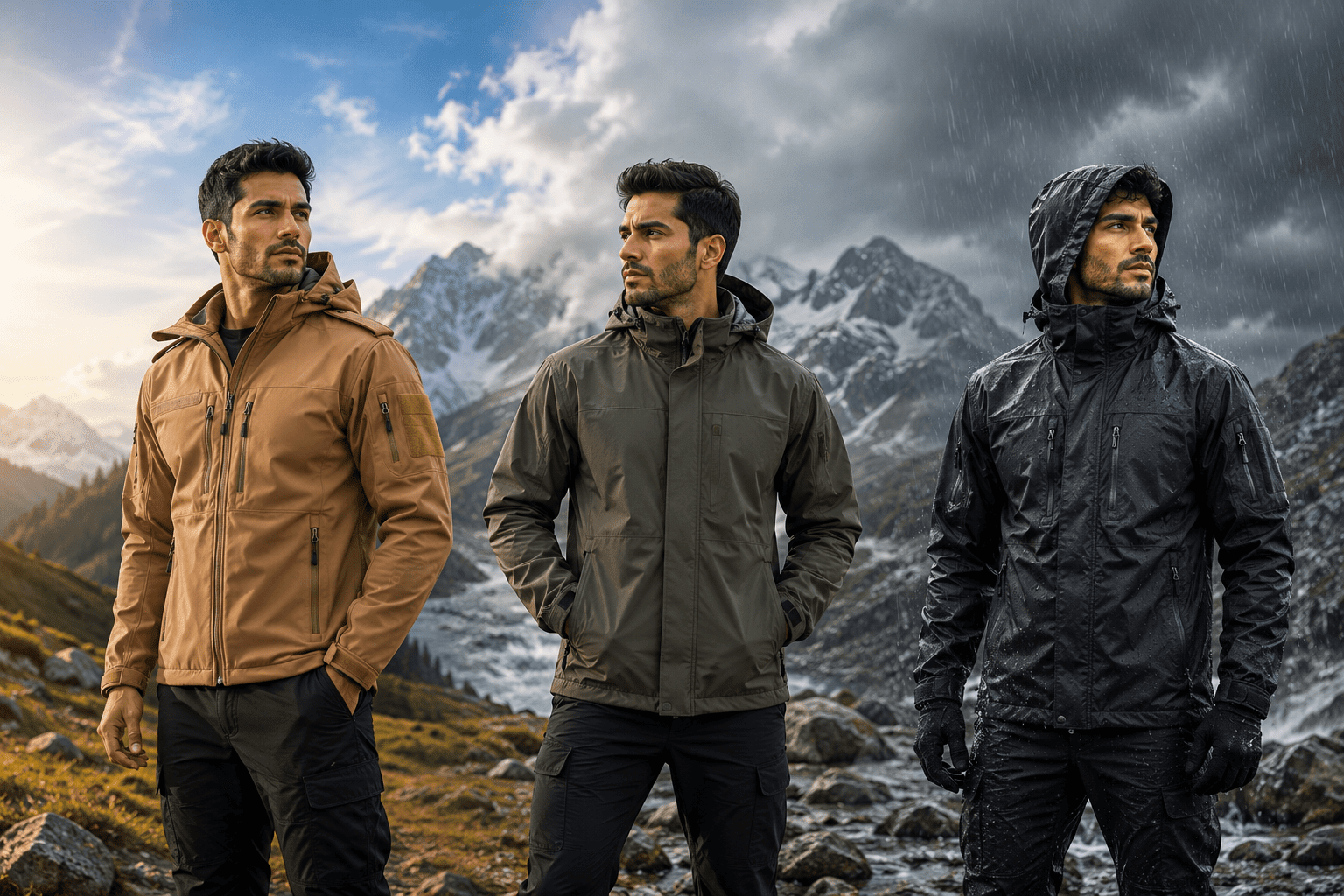
Blog Article
Softshell vs Windbreaker vs 3-Layer: Which Jacket for Which Indian Condition
Softshell vs Windbreaker vs 3-Layer: Which Jacket for Which Indian Condition
Choosing between a softshell, a windbreaker, and a laminated three-layer shell depends on three things: how much sustained rain you face, how hard you will be working in the jacket, and whether wind or water is the actual problem. These are separate construction architectures, not grades of the same product, and the layer number printed on a listing describes comfort and durability rather than waterproofness. This guide covers what each construction does, which two specifications are worth checking, and how the choice changes between monsoon plains, Himalayan cold, and a city commute.
Do you need a technical shell, or will any jacket do?
A technical shell earns its cost when one of three conditions applies to how you actually dress. The first is sustained exposure, meaning more than a few minutes of continuous rain or wind rather than a dash from a doorway to a vehicle. The second is exertion, because a jacket worn while walking, riding, or climbing has to move your sweat vapour outward or it will soak you from the inside. The third is temperature swing, where a single garment has to work across a range rather than at one point.
If none of those apply, an ordinary insulated or casual jacket is the honest answer, and the specifications below will not change your comfort. If two or three apply, the differences between these constructions become the difference between a jacket that works and one that gets abandoned in a cupboard after one bad day.
Signs you are ready to buy on specification rather than appearance:
- You have owned a jacket that kept rain out but left you wet inside from sweat.
- You need one garment to cover both a monsoon commute and a hill trip.
- You ride a two-wheeler in conditions where wind chill, not rain, is the daily problem.
- You have paid for a jacket labelled waterproof that soaked through in the first heavy spell.
What do the category names actually describe?
Three architectures sit behind the labels, and each makes a different engineering trade-off across wind resistance, breathability, water resistance, and packability.
A softshell is a category of stretch woven or knit face fabrics, not one specific material. Softshells prioritise breathability, mobility, and comfort during high-output activity over full waterproofing, relying on a durable water repellent finish on the face fabric rather than a sealed and taped membrane. A softshell resists wind and light precipitation and will wet through in sustained rain. Fleece-backed versions add a napped interior that traps air, letting the garment work as a light insulating layer in its own right.
A windbreaker, sometimes sold as a windshell, is the most minimal architecture: a single tightly woven face fabric, often with a light DWR finish, with no waterproof membrane and no seam taping. It blocks wind and sheds drizzle through weave density alone. Windbreakers are engineered for packability and breathability, and they are essentially always uninsulated.
A hardshell uses a fully waterproof, seam-taped membrane construction and is built to be the primary barrier against sustained rain, snow, and wind. What it gives up is stretch and next-to-skin comfort. Almost every jacket sold with a 2L, 2.5L, or 3L label is a hardshell.
| Property | Softshell | Windbreaker | Hardshell |
|---|---|---|---|
| Wind resistance | High | High | Highest, fully sealed |
| Breathability | Highest, air-permeable | High | Moderate to high, membrane-dependent |
| Water resistance | DWR only, wets through in sustained rain | DWR only, sheds light drizzle | Sealed membrane with taped seams |
| Stretch and mobility | High | Moderate | Low to moderate |
| Packability | Moderate | Very high | Moderate to high |
What do 2L, 2.5L, and 3L actually mean?
Layer count describes how the inside of a waterproof jacket is finished, not how waterproof it is. Every waterproof-breathable fabric is built from the same three functional components: a face fabric, a membrane or coating bonded to its inside, and something protecting that membrane from body oils, sweat, and abrasion. The layer number describes only that third element.
In 2-layer construction, the membrane is laminated to the face fabric and the interior is protected by a separate, loose-hanging mesh or taffeta liner. The free-hanging liner adds weight and bulk while giving a warmer, less clammy feel, which is why 2L is common in insulated ski jackets and casual town wear.
In 2.5-layer construction, that hanging liner is replaced by a micro-thin printed or sprayed coating applied directly to the membrane's inner face. The half layer adds almost no weight, making 2.5L the lightest and most packable option, though the coating wicks sweat less effectively than a textile liner and can feel clammy in sustained wear.
In 3-layer construction, a woven or knit backing fabric is fully laminated to the membrane alongside the face fabric, fusing all three into a single composite sheet with no loose liner. The result is the most durable and most breathable-in-practice shell, at higher cost, and it is the standard for mountaineering and ski touring.
A 2L, 2.5L, and 3L jacket built around the same membrane will show similar waterproof ratings. The difference is durability, weight, and how the jacket feels against skin over a long day.

Which numbers should you check, and which are noise?
Two specifications carry real information, and both come with caveats worth knowing before you compare listings.
Hydrostatic head measures the height of a water column, in millimetres, that a clamped fabric sample resists before water penetrates. The test is standardised as ISO 811, which applies steadily increasing water pressure to one face of the fabric at a controlled rate. A 10,000mm rating means the fabric withstood pressure equivalent to a ten-metre column of water. Note that this is a laboratory pressure test rather than a simulation of rainfall, and that the commonly quoted performance bands, roughly 5,000mm for light rain and 10,000 to 15,000mm as the baseline for regular hillwalking, are trade convention rather than figures fixed by any standards body.
Moisture vapour transmission rate measures breathability in grams of vapour passing through a square metre of fabric in 24 hours. The important caveat here is that the test method changes the answer dramatically. One membrane manufacturer running the same physical membrane across multiple standards recorded 10,200 versus 900 grams per square metre per 24 hours depending on which test was used. A breathability figure quoted without its test method is not comparable across brands.
What this means practically: check that both numbers are present and treat a high waterproof rating with no breathability figure as an incomplete specification. A jacket sold on hydrostatic head alone may well keep rain out and leave you soaked in your own sweat, which in Indian humidity is the more likely failure.
Two things also matter that no number captures. Seam sealing is a separate process from the fabric's own rating, and an untaped garment leaks at every stitch line regardless of what the fabric tested at. The condition of the DWR finish on the face fabric matters as much as the membrane underneath, because a saturated face fabric kills breathability even when the membrane is intact.
Insulated or uninsulated: which do you need?
Insulation is a separate axis from both layer count and architecture, and conflating the two is how buyers end up with a jacket that only works for three weeks of the year.
An uninsulated hardshell is a pure weather barrier meant to go over separate insulating layers. An insulated hardshell builds synthetic or down fill inside the shell, which is common in ski jackets and trades packability and versatility for warmth in a single garment. Fleece-backed softshell sits between the two: the brushed interior traps air well enough to work as a light insulating layer on its own in mild cold, without committing you to a fixed warmth level. Windbreakers are essentially always uninsulated, since their whole design intent is minimum weight.
For Indian conditions the uninsulated route wins more often than it loses. A breathable shell over a separately chosen mid-layer covers a far wider temperature range than one insulated garment, which matters across hill-station days that swing sharply between afternoon sun and evening cold. The single exception is static cold, where you are not generating heat through movement and a dedicated insulated piece is simply more efficient than stacking thin layers.
Which features should you check on the jacket itself?
Feature sets converge by architecture, and knowing what each should carry tells you quickly whether a jacket is built for what its label claims.
Hardshells, largely regardless of layer count, converge on an adjustable multi-point hood, cuff adjustment at the wrist, a drawcord or elastic hem, a storm flap over the front zipper, and underarm ventilation zips for when the membrane's passive breathability is overwhelmed by exertion. A jacket sold as a technical rain shell that lacks a storm flap and hem adjustment is worth a second look at the specification.
Softshells usually retain adjustable hems and cuffs while omitting ventilation zips more often, because air-permeable fabric handles ventilation passively. Windbreakers drop the most, frequently going without ventilation zips, storm flaps, and sometimes a hood, relying on overall packability rather than in-use adjustability.
Two details deserve checking on any of the three. Confirm whether seams are fully taped, critically taped at high-exposure points only, or untaped, because that decides whether a waterproof rating means anything at garment level. Check hood adjustment against how you actually wear it, since a hood that will not cinch is the most common reason a good jacket gets used with the hood down in rain.
Which construction suits which Indian condition?
| Condition | What you are fighting | Best-fit construction | What to avoid |
|---|---|---|---|
| Monsoon plains and coastal cities | Sustained high-intensity rain, heat, humidity | Taped 2.5L or 3L hardshell with a genuine breathability figure | Windbreakers and unlaminated softshell; heavily insulated 2L |
| Himalayan winter and high altitude | Sub-zero wind chill, dry cold, intermittent snow | Fleece-backed softshell, or hardshell layered over insulation | Committing to a heavy rain-focused shell for dry cold |
| Hill-station shoulder season | Wide daily swings, sudden shifts between sun, wind, rain | Mid-weight 2.5L hardshell or wind-resistant DWR softshell | Heavy 3L expedition shells and minimal windbreakers alike |
| Urban commuting, non-monsoon | Wind, dust, occasional light showers | Windbreaker or light 2L casual shell | Overbuying a technical hardshell for dry-season use |
Indian monsoon intensity is what drives the first row. The India Meteorological Department classifies daily rainfall in bands running from light through heavy to extremely heavy, and separately defines hourly intensity where an intense spell begins around 15 to 30mm per hour. Rain at that rate will move straight through a windbreaker or an unlaminated softshell within minutes, which is why a genuine taped hardshell is the only honest answer for monsoon exposure. Given the heat and humidity alongside the rain, a lighter 2.5L with ventilation zips is usually more livable than an insulated 2L.
The Himalayan case runs the opposite way. Locations across Himachal record winter minimums well below freezing alongside largely dry conditions outside active snowfall, with gusty winds during western-disturbance passages. Cold, dry, and windy is the textbook case for softshell rather than hardshell, because the problem is wind and heat retention rather than sustained rain, and breathability during high-output trekking matters more than a rain barrier. Our black DWR softshell sits in this band, as does the 10 zip outpost jacket for colder, more static days.
For daily riding and walking in dust and wind outside monsoon season, a windjacket covers the actual conditions at a fraction of the weight of a hardshell. If a field jacket silhouette suits you better for city use, our M65 buyer's guide covers that route.
Three mistakes buyers make in this category
Buying a windbreaker expecting monsoon performance. Retail listings use windbreaker, wind shell, and rain jacket interchangeably, and a genuine windbreaker has no membrane and no taped seams. The consequence is a soaked wearer who concludes that waterproof jackets do not work, when the garment was never rated or constructed for sustained rain. The fix is to check for a stated hydrostatic head figure and taped seams before buying, not to trust the category name.
Ranking by layer count. Buyers commonly assume 3L beats 2.5L beats 2L in absolute protection, which is not what the numbers describe. A well-made 2.5L can match a 3L jacket on both waterproof rating and breathability on paper, differing mainly in liner durability and feel. The practical consequence runs both ways: overpaying for a heavy mountaineering shell to walk to an office, or underbuying a 2.5L with an unexpectedly low rating for genuine monsoon use.
Mistaking wetting out for a leak. When the DWR finish on a face fabric degrades, the outer fabric saturates, breathability collapses, and sweat builds up inside. Wearers routinely diagnose this as membrane failure when the membrane is usually intact and the finish simply needs reactivating or reapplying. Washing the garment and applying gentle heat restores the finish in most cases, and a jacket does not need replacing on the first cold, clammy day.
The layered approach beats the single-garment approach in most Indian conditions, which is why a breathable outer over separate insulation outperforms one heavily insulated shell across a wide temperature range. For cold-weather trips where insulation and weather resistance need to arrive together, our woodland three-layer jacket handles both without the bulk penalty of an insulated hardshell.
Frequently asked questions about jacket construction
Can one jacket cover both Indian monsoon and Himalayan winter?
A single jacket covers both only as a compromise that underperforms in each. Monsoon calls for a taped, breathable hardshell, while Himalayan cold calls for wind resistance and insulation with far less emphasis on a rain barrier. The workable compromise is a mid-weight hardshell paired with separate insulation you add or remove, which handles both without the weight of an insulated expedition shell.
How long does a waterproof jacket stay waterproof?
The membrane in a well-made hardshell typically outlasts several years of regular use, while the DWR finish on the face fabric degrades far sooner and is the part that usually fails first. Beading that stops within the first season is normal and does not indicate a defective jacket. Washing with a technical cleaner and applying low heat restores the finish, and reproofing products replace it once heat alone stops working.
Are pit zips worth paying for in Indian conditions?
Pit zips are worth having in humid Indian conditions, where a membrane's passive breathability is often overwhelmed by sweat rate during exertion. Underarm ventilation dumps heat and moisture faster than any membrane can, which matters more during monsoon and in coastal humidity than in dry cold. Softshells frequently omit them because their fabric is air-permeable enough to vent passively.
Does a more expensive membrane always breathe better?
A more expensive membrane usually offers a higher stated breathability figure, but the number depends heavily on the test method used, and figures from different standards are not directly comparable. Face fabric condition, ventilation features, and fit all affect real-world comfort as much as the membrane specification does. A mid-range membrane in a well-ventilated jacket often outperforms a premium membrane in a sealed one.
What is the difference between water-resistant and waterproof on a jacket listing?
Water-resistant describes a fabric that delays soak-through through tight weave or a light coating, usually with unsealed seams, while waterproof describes a system combining an impermeable membrane with sealed seams. The terms are not two points on one scale and are not regulated to a fixed numeric threshold for apparel. A jacket labelled water-resistant will not become waterproof under heavier rain; it fails by gradual soak-through everywhere.


Comments
Leave a comment
Your email address will not be published. Required fields are marked *
No comments yet. Be the first to share your thoughts!