


Cart
0

Blog Article
YKK Zippers and Tactical Hardware: What the Spec Buys You
YKK Zippers and Tactical Hardware: What the Spec Buys You
A hardware code on a product page is a manufacturer part number, not a marketing flourish. "YKK #8 VISLON" names a maker, a size, and a construction type, each checkable against the maker's own documentation. Reading those codes separates a genuine durability claim from a cosmetic one, which matters in Indian conditions, where monsoon humidity, coastal salt air, and dust routinely destroy hardware faster than the fabric around it.
What are the parts of a zipper called?
A zipper has three primary components. The elements are the interlocking teeth or coil, called the chain when meshed. The slider engages and disengages that chain. The tape is the fabric strip, usually polyester, sewn either side and stitched into the garment.
Two further parts decide how a zipper is terminated. Top and bottom stops prevent the slider running off either end, and on separating zippers such as a jacket front, an insertion pin and retainer box let the halves fully part and relock. Length is measured stop to stop, not across the full tape.
What does the gauge number mean?
The number after the hash, as in #3, #5, or #8, denotes the approximate width in millimetres of the chain when closed. It describes size, not strength.
| Gauge | Typical application |
|---|---|
| #3 to #4.5 | Trousers, internal pockets, light activewear |
| #5 to #7 | Jacket fronts, boots, packs |
| #8 to #10 | Heavyweight parkas and outer shells |
Sliders and chains are matched rather than interchangeable. A #8 chain requires a #8 slider, and a slider built for moulded teeth will not engage a coil chain. Fitting a mismatched slider causes failure.
Which zipper construction should you want?
Three chain technologies cover almost everything.
- Coil uses a continuous nylon or polyester monofilament coiled and stitched onto the tape. It distributes stress along the whole coil rather than at single points and flexes well around curves, making it the lightest option. Coil is more prone to separating or jamming under heavy side-load or with grit in the channel.
- Moulded plastic has individual teeth injection-moulded from acetal resin onto the tape. It resists lateral pull better than coil, does not corrode, and holds up to UV. A broken tooth cannot be repaired, only replaced.
- Metal has teeth stamped from brass, aluminium, or nickel and clamped onto the tape. Metal offers very high strength for its size, is the heaviest by a clear margin, and corrodes in salt or sustained moisture.
The assumption that metal always outlasts the alternatives does not survive contact with the trade. Metal has the highest raw strength and the worst corrosion behaviour, while moulded plastic resists corrosion and UV entirely. Repair trades report coil, not metal, as the most frequent failure point on separating jacket fronts. That is field observation rather than controlled testing, but it points the opposite way to the folk rule.
What does a hardware code actually encode?
A single manufacturer code carries several attributes in sequence. In YKK's own code glossary, a leading letter denotes chain type, with C for coil, V for the moulded VISLON line, and M or R for metal. What follows encodes function, element size, slider body, pull-tab style, and tape width. Suffixes cover compliance rather than durability.
None of these codes certifies a strength or cycle-life figure. A code tells you what the component is; only a published datasheet tells you how it performed under test.
Are water-resistant and waterproof zippers the same thing?
They are not, and this is where marketing conflation is worst. YKK addresses it directly, calling the confusion between its water-protective lines one of the most common misunderstandings among customers and industry alike.
Water-repellent zippers laminate a polyurethane film to the reverse of the chain and add a repellent coating. They shed surface water and light spray, are not pressure-tested to a sealed standard, and the lamination can peel with wear. Genuinely sealed zippers combine moulded teeth with a physical seal between the elements, are pressure-tested in production, and in non-metallic lines contain no metal at all.
Reverse coil is frequently misread as a waterproofing method. Mounting the coil so teeth face inward is an orientation choice giving a cleaner exterior and some protection against grit. It confers no water resistance unless combined with a coating or laminated seal. Treat any zipper marketed as waterproof without a named sealed line or stated pressure rating as unverified.
What else on a garment carries a quality signal?
Zippers are the most visible hardware, and three other components tell you as much about a garment.
Hook-and-loop fastening is specified by cycle life, meaning open and close cycles before holding performance drops to half its initial value. Velcro's datasheet for its 13G hook line specifies 50% minimum of initial performance after 10,000 cycles. Every disengagement drags hooks through loops, shearing loop fibres. Woven constructions sustain far more cycles than the bonded ones used in disposable products.
Snap fasteners are graded by closing force, opening force, and attachment strength, with salt-spray testing where rust counts as failure. Buckles are usually acetal or nylon: acetal is stiffer and absorbs less moisture, nylon takes impact. The ASTM standards covering zippers note directly that no one test determines fitness for an end use.
Which hardware survives Indian conditions?
Coastal Indian cities combine monsoon humidity with sustained marine salt exposure, which attacks hardware faster than fabric.
- Metal chain is most vulnerable to salt-air corrosion, with alloy and plating quality deciding how quickly rust appears.
- Moulded plastic does not corrode and resists UV, the more climate-stable choice for coastal garments.
- Coil does not rust, though the thread binding it to the tape degrades under prolonged UV and grit causes jamming.
- Laminated water-repellent coatings peel with extended flexing, removing the water-shedding benefit.
No manufacturer or standards body models Indian monsoon and coastal conditions as a certified test environment, so this ranking comes from general material behaviour rather than a local field study. For humid and coastal use, moulded or fully sealed constructions carry lower corrosion risk than metal. Our 12 zip softshell and ripstop tactical pant both use original YKK hardware, and our tactical pants guide covers what else to check. On a jacket like the 10 zip outpost, where closures outnumber almost every other component, hardware quality is most of what you are buying.
Frequently asked questions about garment hardware
How can I tell whether a zipper is genuine YKK or a counterfeit?
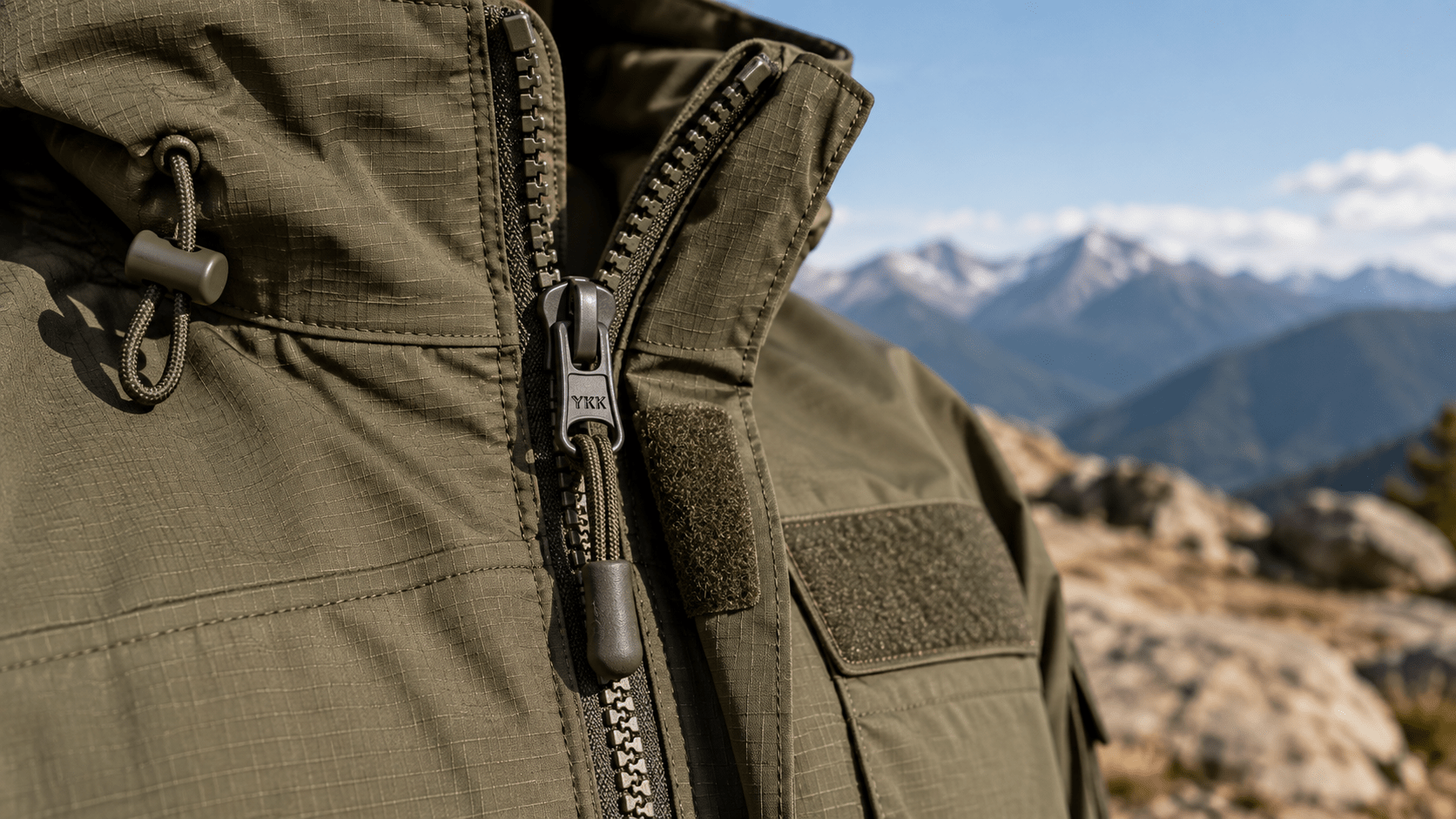
Genuine slider lettering is cast with three-dimensional depth and sharp edges, while counterfeits show flat or printed lettering. Genuine sliders are die-cast zinc alloy and non-magnetic, so a small magnet is a fast field test against stamped-steel fakes. These checks reflect factory quality-control practice, not a manufacturer standard.
Does a branded pull tab mean the whole zipper is genuine?
A branded pull tab guarantees nothing about the rest of the component. Counterfeit sliders are routinely fitted to unbranded chain and tape, so a convincing logo says nothing about tape weave, tooth plating, or corrosion resistance. Check the whole component set.
Can a broken zipper on a jacket be repaired, or does it need replacing?
Repairability depends on what failed. A worn slider can usually be replaced without touching the chain, the commonest and cheapest repair across all three constructions. Coil teeth can often be realigned with pliers, while a snapped moulded tooth requires replacing the chain.
Why do zippers on Indian coastal-use garments fail faster?
Coastal conditions combine sustained humidity with marine salt aerosol, which corrodes metal in a way inland dry heat does not. Metal chains and stamped-steel sliders rust first, and dust ingress compounds it by abrading the channel. Rinsing hardware with fresh water after coastal exposure extends life more than any other habit.


Comments
Leave a comment
Your email address will not be published. Required fields are marked *
No comments yet. Be the first to share your thoughts!