


Cart
0

Blog Article
Multicam, Woodland, Desert, Black: The Visual Guide to Tactical Camouflage Patterns
Multicam, Woodland, Desert, Black: The Visual Guide to Tactical Camouflage Patterns
Indian retail listings tend to call everything green and mottled "army camo", which tells a buyer nothing about what they are buying. Four looks dominate the outdoor and lifestyle shelf, and only three of them are patterns at all. MultiCam, Woodland, and Desert are engineered disruptive camouflage patterns, each developed under a specific US military design programme with a documented year of origin. Solid black is a flat colour with no internal contrast, so it does not break up a wearer's outline the way the other three are built to. Knowing which is which changes what you buy for a Himalayan ridgeline, a Western Ghats monsoon trail, or a weekday commute.
What separates a camouflage pattern from a colour choice?
A camouflage pattern is a printed design that uses multiple tones and irregular shapes to break up the visible outline of a wearer against a textured background. MultiCam, Woodland, and Desert each do this with a documented palette and shape structure. Solid black does not, because a flat colour carries no internal contrast to disrupt.
The distinction has practical consequences. Outdoor and survival writing is direct on the point that black is not a camouflage colour, noting that even at night it often reads too dark against ambient light and silhouettes the wearer. Tactical-gear discussion reaches the same conclusion, steering people toward brown, grey, and ranger green for low-visibility use.
How do the four looks differ in origin and design?
Each pattern traces to a dated US design programme.
MultiCam
MultiCam was designed in 2002 by Crye Precision working with the US Army Soldier Systems Center, under the internal name Scorpion. It lost the Army's 2004 uniform trials, then returned officially in 2010 on a MultiCam-based uniform for Afghanistan. A closely related pattern, Scorpion W2, became the permanent Operational Camouflage Pattern from 2015.
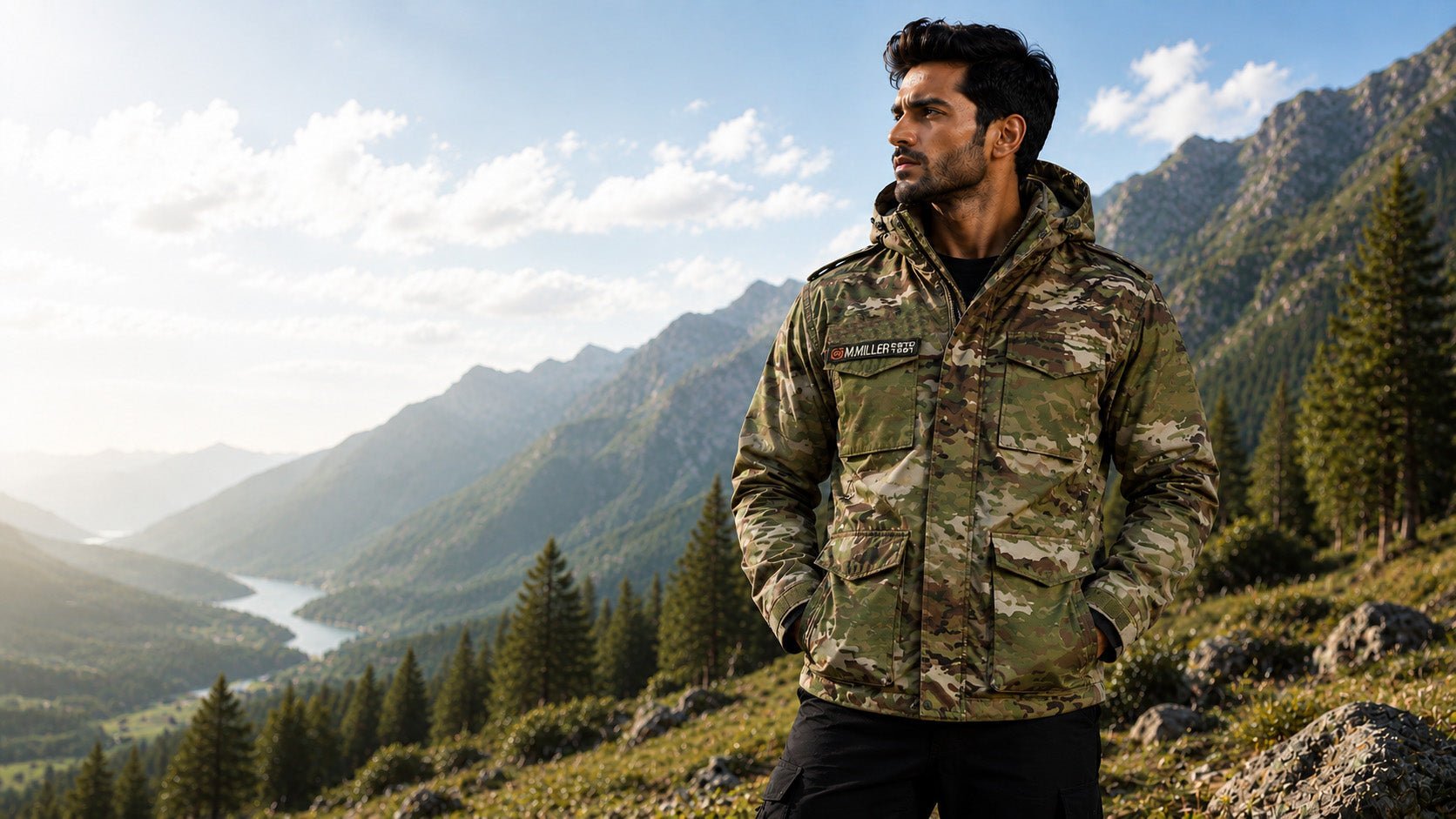
The seven-colour design layers a brown-to-tan gradient background under dark green, olive, and lime shapes, topped with small opaque brown and cream branch-and-twig elements. That layering lets the pattern shift its dominant tone, reading greener in vegetation and browner on open ground. Crye released a formal variant family in November 2013: Arid, Tropic, Alpine, and Black.
Woodland
Woodland, nicknamed M81 for its adoption year, was the standard US military pattern from 1981 until roughly 2012. It descended from the Vietnam-era ERDL design, keeping the same four-colour palette but enlarging the pattern elements by 60 percent, which extended effective disruption to around 350 metres.
The four colours are green, brown, sand, and black, arranged in irregular organic blotches rather than pixels.
Desert
Desert camo on a product page can mean either of two distinct patterns. The six-colour design, known as chocolate chip for its speckled rock shapes over tan and brown, saw heaviest use in the 1990 to 1991 Gulf War. Field experience showed the black speckles stood out against flat sand, and replacement began in 1991.
The three-colour Desert Camouflage Uniform pattern was developed at Natick Laboratories to fix exactly that, using dark brown, pale olive green, and beige with no black speckling. The US Army Infantry School approved it in October 1990, with wide issue by 1992.
Solid black
Solid black serves visual authority and uniformity rather than concealment, which is the stated rationale behind Crye's own MultiCam Black variant marketed at law-enforcement units.
For an Indian civilian buyer, black is the low-maintenance, dirt-hiding, city-appropriate option that reads as deliberate in a crowd. It is a styling and practicality choice, and treating it as a trail-concealment tool misreads what it does.
Which pattern suits which Indian terrain?
None of these patterns were engineered against Indian reference terrain. All four were developed against US environments, so the mapping below extrapolates from design intent rather than from any validated field testing in Indian conditions.
| Pattern | Design intent | Closest Indian fit |
|---|---|---|
| MultiCam | Transitional, effective across mixed terrain and light | Multi-terrain trips crossing forest, ridgeline, and scrub |
| Woodland | Dense temperate forest, high contrast at mid range | Monsoon-season Western Ghats canopy and shadowed trails |
| Desert (3-colour) | Arid ground, flat sand and dust | Dry pre-monsoon plains and semi-arid central India |
| Desert (6-colour) | Rocky desert with shadow-mimicking speckles | High-altitude Himalayan scree above the treeline |
| Solid black | Visual presence, not concealment | Urban wear, commutes, low-light city use |
MultiCam's transitional design is the most forgiving choice for a trip crossing several environments in a day, which is why the multicam achiever pant suits mixed-terrain travel. Woodland's large-scale blotches match the shadow-heavy foliage of a monsoon trek, the environment a woodland tactical t-shirt is built around. Desert palettes work above the treeline and across dry plains, the terrain the desert advanced ripstop pant is cut for. Black stays in the city, where a black durafit t-shirt does its best work.
What do buyers most often get wrong about these patterns?
Four errors account for most of the confusion in this category.
The first is treating "camo" as a single generic look. Retail listings use loose labels like "army print" without naming whether the design is MultiCam, Woodland, or an unlicensed lookalike, obscuring real differences in palette and structure.
The second is reading MultiCam Black as a low-visibility version of MultiCam. It is marketed for urban presence and gear-matching, and its role runs opposite to the original pattern's purpose.
The third is treating the two desert generations as interchangeable. Six-colour and three-colour desert are chronologically and visually separate designs, and the changeover happened for a documented field-performance reason. Buyers who want desert tones for Himalayan rock will find the arid advanced ripstop pant closer to the rockier six-colour intent than to flat-sand three-colour.
Frequently asked questions about tactical camouflage patterns
Is MultiCam better than Woodland for Indian trekking?
MultiCam suits trips that cross several terrain types in a single day, since its layered palette shifts tone between vegetation and open ground. Woodland performs better in one specific environment, dense green forest with heavy shadow, which describes Western Ghats monsoon trails well. Neither has been tested against Indian terrain; the comparison rests on documented design intent.
Does camouflage print serve any purpose for everyday wear?
Camouflage print on everyday clothing functions as styling rather than concealment, and it hides dirt and wear better than solid light colours. The disruptive structure that matters on a trail does nothing meaningful on a commute. Buyers choosing camo for city use are buying a look and a practical dirt-tolerance benefit rather than a functional advantage.
What is the difference between MARPAT and Woodland?
MARPAT is a digital pattern introduced in 2002 that uses pixelated micro-elements, while Woodland is the 1981 design built from large irregular organic blotches. Both use green, brown, and black tones, which is why retail listings often label MARPAT as woodland camo. The underlying pattern structures are entirely different.
Does washing and fading change how a camouflage pattern performs?
Woodland's original specification used deliberately dark printing so the fabric would fade toward its intended target shades through wear and washing, which extended usable garment life. Fading shifts a pattern's tonal balance over time. For civilian outdoor use the effect is largely cosmetic, since concealment performance is rarely the reason a buyer chooses the print.


Comments
Leave a comment
Your email address will not be published. Required fields are marked *
No comments yet. Be the first to share your thoughts!