


Cart
0

Blog Article
Ripstop Fabric Explained: What It Is, What It Isn't, and Why It Matters
Ripstop Fabric Explained: What It Is, What It Isn't, and Why It Matters
Most product pages calling a pant or jacket "ripstop" leave a buyer guessing about what the word actually changes. Ripstop is a weaving technique, not a fibre, finish, or quality grade. That means two garments both labelled "ripstop" can feel, breathe, and perform very differently depending on the fibre, weight, and treatments under the same grid. Skip the technicality and you end up paying for a feature that doesn't apply to how you'll use the garment, or skipping one you actually need. This page lays out what ripstop is, how the weave works, what changes between variants, and how to read a product label without guessing.
What is ripstop fabric?
Ripstop is a woven fabric construction in which thicker reinforcing threads are interwoven at regular intervals, typically every 5 to 8 millimetres, into a lighter base weave to form a visible crosshatch grid. The grid does not prevent tears from starting; it stops them from spreading once they do. The technique can be applied to nylon, cotton, polyester, or blends, which is why "ripstop" describes the construction, not the material.
The technique entered textile vocabulary during the Second World War, when engineers at DuPont and U.S. military research labs adapted centuries-old sailmaking practice to keep punctures in nylon parachute canopies from running into catastrophic tears. The first formal patent on the technique was filed in 1962 by inventors at the U.S. Army. The civilian outdoor market picked it up through the 1960s and 70s, in tents, sleeping bags, and packs, and the weave now appears across pants, jackets, t-shirts, packs, kites, sails, and flags.
How does ripstop actually work?
Picture a standard woven fabric as a regular grid of threads crossing each other. In a plain weave the threads are all roughly the same thickness, so a tear follows the weakest path through the structure and can run for centimetres before stopping. In a ripstop weave, the manufacturer interrupts that uniform grid every 5 to 8 millimetres, roughly the size of a small pea, by inserting a noticeably thicker yarn in both the lengthwise and widthwise direction.
That creates a series of enclosed squares. When a tear starts, it runs into the nearest reinforcing yarn and stops there, because tearing through the thicker yarn requires significantly more force than tearing through the base. The damage stays compartmentalised. A useful mental model: ripstop limits how far a small failure can travel, the way firebreaks limit how far a spark can spread.
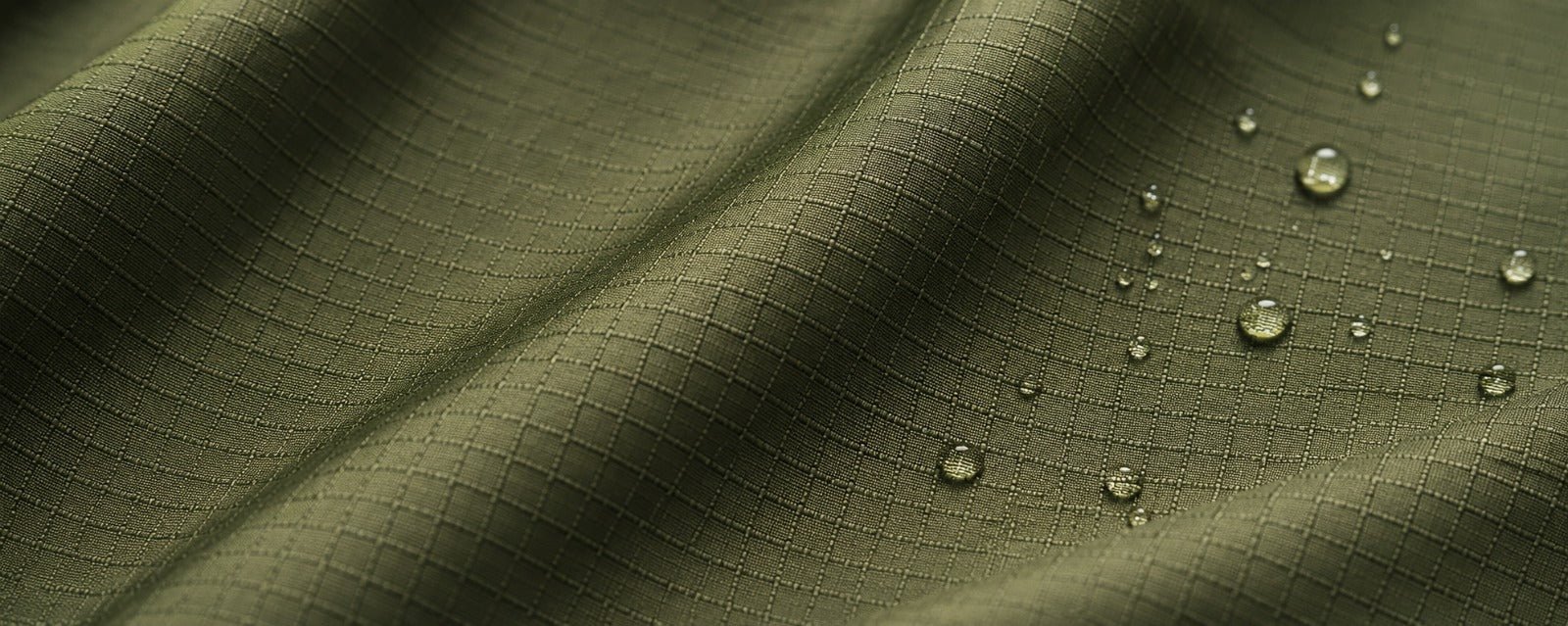
The grid is visible on the fabric surface, with small squares anywhere from 2 × 2 mm in micro ripstop up to 10 × 10 mm in heavier industrial variants. If you can't see a faint grid on a pant labelled "ripstop," the listing may be inaccurate.
What are the key characteristics of ripstop?
- It's a weave, not a fibre. Nylon ripstop, cotton ripstop, polyester ripstop, and blends like NYCO (50/50 nylon-cotton) and 70/30 cotton-poly are all genuine ripstop fabrics, with very different feel, weight, and behaviour.
- It stops tear propagation, not abrasion. A snag on a thorn or a small puncture stays localised. Repeated rubbing against rock or concrete is a different problem; the raised grid threads tend to fray first.
- Weight is told by GSM, not by the word "ripstop." Apparel ripstop typically runs from 60 gsm (lightweight shells) to 220 gsm (tactical and outdoor pants) to 300 gsm (workwear canvas). For pants worn in Indian conditions, 150 to 220 gsm is the practical range.
- Finishes are separate. Water repellency, UV protection, and stain resistance are surface treatments applied after weaving. None of them are inherent to ripstop.
- The grid is the diagnostic. If the visible crosshatch isn't there, the fabric isn't ripstop, regardless of what the listing says.
How is ripstop used in outdoor and tactical apparel?
The dominant fibre choices in the Indian market reflect a balance between climate and use. A 70 percent cotton, 30 percent polyester ripstop is the standard for tactical pants worn through Indian summers, used in the OG Ripstop tactical pant and across the tactical pants collection. The cotton handles heat, the polyester adds tear resistance and dries faster than pure cotton.
A nylon-Lycra blend at 93/7 or 80/20 is favoured for lighter trekking-leaning pants where stretch and quick-dry matter more than thermal comfort, as seen in the PathFinder trekking pant and in stretch-panel constructions like the Advanced Ripstop tactical pant and its Multicam variant, which pair a cotton-poly main body with 80/20 nylon-Lycra panels at the knees and crotch gusset. NYCO 50/50 is the international tactical standard and appears in premium imports rather than domestic Indian retail.
Finishes layered on the weave determine wet-weather performance. A DWR coating, short for Durable Water Repellent, raises the fabric's surface tension so droplets bead up rather than soaking in. It is genuinely water-resistant against light rain and splashes, but is not a waterproof barrier under sustained downpour pressure. A polyurethane coating bonded to the inner face makes the fabric waterproof but kills breathability and is rarely seen on pants worn during physical activity. UPF ratings between 30 and 50+ are common on ripstop pants; tighter weaves and certain dyes raise the rating.
What are the most common misconceptions about ripstop?
- "Ripstop is waterproof." The weave has gaps between threads. Water repellency requires a DWR finish, and waterproofing requires a PU or laminate coating applied separately.
- "Ripstop is always tougher than non-ripstop." Tougher against tear propagation, yes. Against abrasion, often not. A 500D Cordura plain weave outlasts a 70D ripstop nylon on rough surfaces.
- "All ripstop is the same." A 100 gsm polyester ripstop shell and a 220 gsm cotton-poly ripstop pant share a weaving technique and nothing else.
- "Ripstop signals premium pricing." It appears on garments under ₹1,000 and on technical pants above ₹8,000. The weave adds modest manufacturing cost; the premium comes from fibre quality, weight, finishes, and construction.
- "Ripstop is only for extreme use." The same weave used in a parachute canopy is present in lightweight casual shirts, travel pants, and fashion cargo shorts. Ripstop is simply a weave that provides better tear resistance than plain weave at similar or lower weight; that benefit is useful at any use intensity.
What ripstop variants exist and how do they differ?
The fibre choice changes almost everything about how a ripstop garment behaves in use. Five variants dominate outdoor and tactical apparel:
Nylon ripstop is the original. Light, hydrophobic on its own, naturally elastic, and stronger per gram than any of the alternatives. Apparel-grade nylon ripstop runs from 20 denier (ultralight shells and running gear) up to 200 denier (tactical jackets and workwear). Pure nylon ripstop is not particularly breathable and costs more than cotton or polyester equivalents. It is the right choice when weight and moisture management dominate the spec.
Cotton ripstop brings natural breathability and a softer feel against skin, which matters for all-day wear in India's warm climate. It is heavier and slower to dry than synthetics, but it does not melt when exposed to a spark or flame the way nylon and polyester can. Pure cotton ripstop at 150 gsm is common in workwear; heavier 300 gsm cotton ripstop sits in canvas-adjacent applications.
Polyester ripstop is stiffer than nylon, lacks natural elasticity, but resists UV degradation better and costs less. It is widely used in paraglider canopies, kites, and budget outdoor pants. Polyester ripstop in apparel typically runs 60 to 150 gsm for shells and 120 to 210 gsm for pants.
NYCO is the acronym for a 50/50 nylon-cotton blend specifically engineered for apparel that needs both durability and all-day comfort. The nylon component increases tear resistance, abrasion resistance, and partial water repellency; the cotton component provides breathability, moisture absorption, and a natural feel. NYCO is the tactical industry standard internationally and appears in premium imports rather than mass Indian retail.
Cotton-polyester ripstop is the most common blend in Indian tactical and outdoor pants retail. The dominant specification is 65 percent polyester, 35 percent cotton, used widely in workwear globally. Indian brands commonly use a cotton-rich 70/30 ratio that gives a slightly softer, more breathable feel suited to hot Indian conditions while retaining the tear-containment structure of the ripstop weave. A stretch variant adds 2 to 3 percent spandex or Lycra, enabling the fabric to flex and recover.
How to read a ripstop product label
A few specifics worth extracting from any product page before paying:
| What to look for | Why it matters |
|---|---|
| Fibre composition (e.g., 70/30 cotton-poly, 93/7 nylon-Lycra) | Tells you breathability, drying speed, and feel; cotton-rich for heat, nylon-rich for sweat and weight |
| GSM or garment weight | 150 to 180 gsm for trekking pants in Indian conditions; 190 to 220 gsm for harder tactical use |
| Finish (DWR, UV / UPF, Teflon) | Adds wet-weather performance, sun protection, or stain resistance; none of which are inherent to the weave |
| Stretch (4-way, 2-way, mechanical) | Determines how the pant moves with you for climbing, scrambling, or extended walking |
| Hardware (YKK zippers, bartacked seams, gusset) | The most reliable durability tell after fabric; better signal than the word "ripstop" alone |
A practical rule of thumb: for pants worn in warm Indian conditions, look for cotton-rich blends at 180 to 220 gsm with a DWR or Teflon finish and 4-way stretch if your use includes any climbing, squatting, or scrambling. For trekking-leaning use in cooler or wet conditions, look for nylon-rich blends at 150 to 200 gsm with full-garment DWR and a UPF rating, available across the PathFinder colour range. Below 120 gsm in a garment marketed as "tactical pants" is a red flag for thin fabric.
Frequently asked questions about ripstop fabric
Is ripstop fabric waterproof?
Ripstop fabric is not waterproof by construction. The weave has gaps between threads, and the only thing the grid contributes is tear resistance. Water repellency requires a DWR finish on the surface, which handles light rain and splashes but eventually saturates under sustained downpour. True waterproofing requires a polyurethane or laminate coating bonded to the fabric, usually at the cost of breathability, which is why most ripstop pants are water-resistant, not waterproof.
What's the difference between nylon ripstop and cotton ripstop?
Nylon ripstop is lighter, drier, and stronger per gram, with natural elasticity and a more technical feel; best for cooler conditions, fast-drying needs, and heavy exertion. Cotton ripstop is heavier, slower to dry, and noticeably more breathable in heat, with a softer hand against skin. For Indian summers and daily wear, cotton-poly blends balance the two; for trekking in warm dry conditions, nylon-rich wins on weight and moisture management.
Does ripstop wear out faster than regular fabric?
Ripstop typically lasts longer than a plain weave of the same fibre and weight, because a small snag or puncture stays contained instead of running into a torn-open garment. The exception is heavy abrasion against rough surfaces like rock or concrete, where the raised reinforcing yarns are the first to fray. For most pant use cases short of rock scrambling, ripstop construction extends garment life rather than shortens it.
Is heavier ripstop always better?
Heavier ripstop is more durable but also less breathable and more uncomfortable in heat. For pants worn in Indian conditions, 150 to 180 gsm is comfortable for trekking and travel, 190 to 220 gsm suits tactical and harder outdoor use, and anything above 250 gsm is workwear territory. The right weight depends on use; "heavier" is not a universal upgrade.

