


Cart
0

Blog Article
Trekking Pants vs. Tactical Pants: Which Should You Wear?
Trekking Pants vs. Tactical Pants: Which Should You Wear?
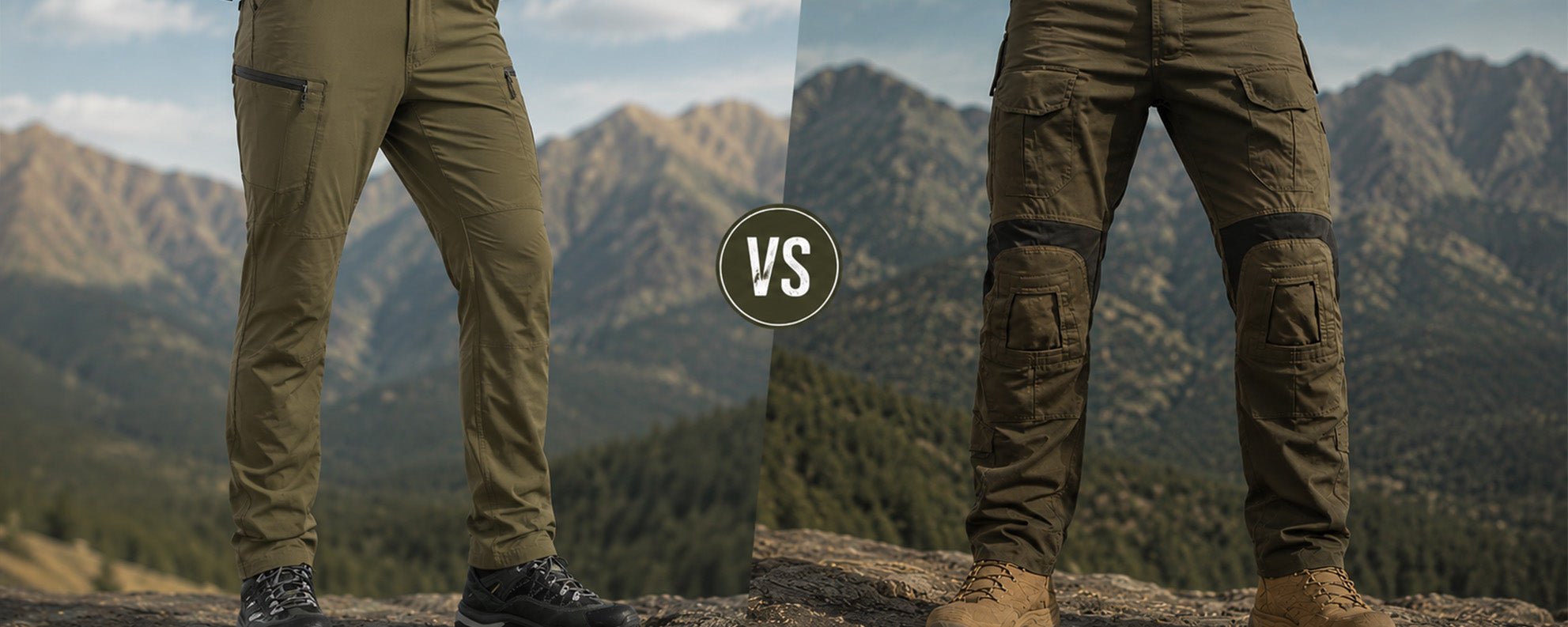
Picking between trekking pants and tactical pants for the same trip is one of the more common, and more costly, mistakes Indian outdoor buyers make. The pants look similar on a marketplace listing: synthetic fabric, reinforced knees, a row of cargo pockets, a confident-sounding name. They are built for different jobs. A trekking pant is engineered around weight reduction, moisture management, and freedom of movement for hours of continuous exertion. A tactical-style pant is engineered around seam strength, pocket volume, and a stand-sit-kneel work posture. For a multi-day Himalayan trek, a trekking pant is unambiguously the right choice. For daily urban wear, travel, and short outdoor stints, a tactical pant has the edge. For most readers in India, the honest answer is to own one of each.
What's the actual difference between trekking and tactical pants?
Both categories sit in the synthetic-or-blend, multi-pocket, reinforced-construction family. Both descend from older work and field trousers, and both now serve civilian outdoor and utility use. The difference is in what each design optimises for.
A trekking pant is built to carry as little fabric as possible while moving sweat off the skin, allowing a full leg-extension stride, and surviving incidental snags from rock and brush. A tactical pant in civilian use is built to carry actual gear in multiple pockets, hold a belt comfortably for an active standing day, and absorb scuffs from kneeling, squatting, sitting on hard surfaces, and dragging through doorways and seats. The categories overlap in the mid-range. A 4-way stretch tactical pant with a lighter base fabric performs close to a trekking pant, and a trekking pant with deep cargo pockets handles light tactical-style storage, but the engineering priorities don't fully meet.
Quick comparison: trekking vs. tactical at a glance
| Feature | Trekking pant | Tactical-style pant |
|---|---|---|
| Fabric weight | 145–230 g/m² | 230–350 g/m² |
| Primary fibre | Nylon (polyamide) or polyester, often with elastane | Cotton-poly ripstop (65/35 or 70/30), or stretch poly-cotton |
| Stretch | 4-way stretch standard at mid-tier | 2-way or mechanical stretch; 4-way at premium |
| Pocket count | 4–6 (zip-secured) | 6–10 (open and bellow cargo) |
| Waistband | Elastic or drawstring, often no belt loops | Conventional with 5–7 belt loops |
| Knee construction | Articulated, sometimes with stretch insert | Articulated and/or knee-pad pocket |
| Wet-weather finish | DWR standard mid-tier and above | DWR inconsistent; entry-tier often untreated |
| UV protection | UPF 30–50 inherent or rated | Often unrated, except at premium |
| Best for | Multi-day treks, single-day hikes, travel | Daily wear, urban utility, camp use, motorcycling commutes |
What defines a trekking pant?
Trekking pants exist for sustained aerobic effort. Every design decision serves that one priority. Garment weight is kept low, typically 200 to 350 grams for a finished pant, because every gram is something you carry on your body for 8 to 10 hours a day. Fabric is overwhelmingly synthetic: nylon and polyester move sweat off the skin and dry within an hour or two, while cotton holds moisture and turns cold at altitude. Mid-range and premium trekking pants add 4-way stretch through elastane content so the leg can extend freely on steep ascents, and a diamond gusset in the crotch, often in a different and stretchier fabric than the main body, prevents seam strain when you spread your legs across a step.
Most trekking pants use an elastic or drawstring waistband with one central loop or none at all. The reason is structural: on a multi-day trek, your loaded backpack's hip belt transfers 70 to 80 percent of the pack weight onto a band that sits directly over your iliac crest. Any rigid buckle, hard belt, or wide waistband on your pants creates a pressure point against that band, and several hours of contact creates bruises that can end a trek. The elastic waist of a trekking pant simply disappears under the hip belt.
At the cuff, trekking pants commonly carry a drawcord or velcro tab so you can cinch the leg over a boot, preventing debris and snow from entering. A DWR finish handles the light rain and spindrift typical of Himalayan passes without needing to immediately layer a rain shell, though no trekking pant is waterproof in a sustained downpour. UPF protection between 30 and 50 is standard either through fabric choice or post-treatment, since UV exposure increases roughly 10 to 12 percent for every 1,000 metres of altitude gained, which matters more than buyers usually expect on a Himalayan trail.
Within the MountMiller range, the PathFinder trekking pant sits in this category: a 93/7 nylon-Lycra ripstop with 4-way stretch, eight pockets including hidden thigh compartments, knee articulation, an adjustable hem drawcord, and a Teflon-finish for water repellency. The same construction runs across the Multicam, Forest Olive, Navy, and Black variants for buyers who prefer specific terrain or urban colourways.
What defines a tactical-style pant?
Tactical-style pants, used here in the civilian utility sense, were derived from older field trousers and have evolved into a category of rugged everyday-and-outdoor utility pants. The engineering priority is structural durability and storage volume rather than minimum weight.
Fabric is heavier, typically 230 to 350 grams per square metre, and the dominant blend in India is a cotton-poly ripstop. Most often 65 percent polyester and 35 percent cotton in the global standard, or a 70/30 cotton-rich variant in domestic Indian retail that handles heat better. The cotton content gives the pant a softer hand against skin and better breathability in dry warmth, at the cost of slower drying and more weight. Premium stretch variants add 2 to 5 percent Lycra or spandex, or use a mechanical-stretch weave, to allow squatting and kneeling without restriction.
Pockets are the visible signature: 6 to 10 across the garment, with bellowed cargo pockets on the thighs sized to carry tools, snacks, a phone, a power bank, and small first-aid items without needing a bag. The thigh pockets sit lower than on a trekking pant and face slightly outward, giving seated access; useful on a bike, in a vehicle, or at a camp. Belt loops are conventional and sized for a 1.5 to 2 inch belt, because the intended wearer is on their feet rather than under a hip-belt pack.
Reinforcement focuses on the knee panel and the seat. Many mid-tier and premium tactical pants include a hidden pocket inside the knee panel sized for a foam or hard knee-pad insert, useful when kneeling on rough ground or a hard floor. The crotch gusset is gusseted but often executed in the main body fabric rather than a stretchier panel, which means tactical pants accommodate sit-squat-kneel motion but not the extreme leg extension of a steep trail climb.
Within the MountMiller range, the OG Ripstop tactical pant represents the cotton-poly core spec, while the Advanced Ripstop line adds 80/20 nylon-Lycra stretch panels at the knees and crotch gusset for buyers who want tactical construction with closer-to-trekking mobility. The full tactical pants collection carries solid colourways and pattern variants across both lines.
Use case 1: Multi-day Himalayan trek
A multi-day Himalayan itinerary, whether Kedarkantha, Hampta Pass, Roopkund, or Sandakphu, pushes every variable that separates the two categories. Trekking pants are the right tool, and the gap widens by the day.
Moisture management compounds across hours of walking. A cotton-heavy tactical fabric can become wet and cold within an hour on a sweaty climb, then refuse to dry for another four. A nylon-rich trekking pant pushes moisture out and dries while still on the body. Layering compatibility becomes essential above 3,500 metres where base-layer thermals are essential morning and evening; the soft elastic waist of a trekking pant sits comfortably over a thermal base, while the conventional belt-and-buckle waistband of a tactical pant fights against that base layer. Cuff sealing, the drawcord or velcro tab at the ankle, keeps grit, snow, and the occasional leech out of the boot. And the cumulative weight of 200 to 300 grams of extra fabric, carried on the body, adds up across consecutive days in a way buyers rarely register before they feel it.
Use case 2: Single-day hike in the Western Ghats or Sahyadris
For a single-day trail under 2,000 metres in the warmth and humidity of the Sahyadris, Western Ghats, or peninsular foothills, either category works, with a slight edge to trekking pants in hot-humid conditions. A lightweight stretch tactical pant in a thinner poly-cotton blend is acceptable, especially if the goal is to wear the pant casually after the hike. A heavy 70/30 cotton-poly tactical pant in monsoon will hold rainwater and chafe within hours. If most of your hiking is single-day low-altitude work in hot conditions, a trekking pant is the safer default; if your day mixes a short hike with a long café stop, a stretch tactical works.
Use case 3: Motorcycling
Neither trekking pants nor tactical pants are CE-rated riding gear, and dedicated textile riding pants (Rynox Air GT at around ₹5,800 is a strong Indian option) remain the safest choice for anyone prioritising crash protection. That said, a large share of Indian riders commute and tour in tactical-style pants rather than full riding kit, and among those riders, the MountMiller Advanced Ripstop has become a popular pick. The 80/20 nylon-Lycra stretch panels at the knees and crotch gusset give the pant enough flex to handle a riding posture comfortably, while the 70/30 cotton-poly ripstop body provides noticeably more abrasion resistance than a lightweight nylon trekking pant. The 10-pocket layout also suits riders who carry a phone, wallet, keys, and tools distributed on the body rather than in a bag.
A thin nylon trekking pant (145 g/m² constructions) will shred immediately in even a low-speed slide and is the wrong choice for any riding scenario. If you ride regularly and a dedicated riding pant is not in the budget or the wardrobe, a heavier cotton-poly ripstop tactical pant is the functional compromise at city speeds. At highway speeds, neither category provides meaningful protection.
Use case 4: Daily urban wear and travel
For daily urban wear, whether café, market, casual office, or commute, a slim or straight-cut tactical pant in olive, khaki, or black reads as utility cargo trousers and works in most casual Indian settings. The pocket volume is a real, daily advantage: phone, wallet, keys, power bank, and earphones distributed across pockets without needing a bag.
For travel across long flights, train journeys, and multi-city trips, trekking pants pull ahead. The elastic waist stays comfortable across seated hours. Quick-dry nylon can be rinsed in a hotel sink and is dry by morning. The lighter weight means less fatigue through airport walking. A dark-colour trekking pant in navy, charcoal, or dark green — the Forest Olive PathFinder is a useful reference — passes social scrutiny in most Indian urban contexts without reading as overly technical.
Indian retail landscape and pricing
The two categories sit in distinct price bands at Indian retail, with overlap in the middle tier where stretch construction blurs the line.
Trekking pants in India start around ₹1,599 for Decathlon's NH500 and Gokyo's entry models, climb through the mid-tier at ₹2,099 to ₹3,599 for the Decathlon MT500 and Reccy Nomadic, and reach ₹3,999 to ₹6,499 for premium domestic options like the MountMiller PathFinder and Decathlon MT900. Imported brands like Columbia and The North Face land in the ₹4,000 to ₹7,000 range when stocked through authorized Indian retailers, considerably more through grey-import routes.
Tactical pants in India are denser at the entry-to-mid tier. Unbranded surplus and basic 6-pocket ripstop sit at ₹799 to ₹2,000 at army stores and Amazon listings. Mid-tier domestic brands like MountMiller (OG Ripstop), DeltaTac (Ultra Model), and Olive Planet occupy the ₹2,000 to ₹4,000 band, with stretch and reinforced variants at the upper end. The MountMiller Advanced Ripstop and PathFinder bridge into the premium domestic band. Imported premium options from Helikon-Tex and 5.11 Tactical have no authorized Indian dealer presence; grey-imported pieces via Desertcart and similar routes land at ₹18,000 to ₹35,000 after duties, which is 4 to 5 times the international retail price.
Sizing availability is a recurring constraint in both categories. Most Indian domestic brands top out at XL or XXL waist (38 to 40 inches). Buyers above 40 inches at the waist or above 5'11" in height have limited domestic options; Reccy's Tall length variant in the Nomadic line is one of the few explicit accommodations in the Indian market.
How to choose: a decision framework
| Your primary use | Choose | Why |
|---|---|---|
| Multi-day Himalayan trek (3,000 m+) | Trekking pant | DWR, quick-dry, layering, hip-belt compatibility are non-negotiable |
| Single-day trail in dry low-altitude conditions | Either; trekking preferred in heat-humidity | Stretch tactical works if aesthetics or storage matter more |
| Monsoon trail (Sahyadri, Western Ghats) | Trekking pant | Quick-dry nylon vastly outperforms cotton-poly in persistent rain |
| Urban motorcycle commuting | Tactical pant (riding pant still safest) | MountMiller Advanced Ripstop popular among Indian bikers; heavier ripstop and stretch panels suit riding posture |
| Air travel and long train journeys | Trekking pant in dark colour | Elastic waist, quick-dry, packable, socially neutral |
| Daily urban wear and casual office | Tactical pant | Better silhouette, conventional belt loops, pocket utility |
| Camping with active day hikes | Either | Trekking if hikes are demanding; tactical if camp and social mix |
If you only buy one, base the choice on your most frequent use rather than your most aspirational one. A pant bought for an annual trek but worn 350 days a year urban is the wrong pant. A pant bought for daily wear but worn on a serious Himalayan itinerary is the more painful version of the wrong pant.
Frequently asked questions about trekking and tactical pants
Can I use tactical pants for trekking?
Tactical pants work for short single-day treks in dry, low-altitude conditions, especially in stretch poly-cotton variants. They fail on multi-day Himalayan itineraries: the cotton content holds moisture and turns cold at altitude, the conventional belt waistband conflicts with a pack's hip belt, and the extra fabric weight accumulates across consecutive walking days. For anything serious above 2,500 metres, a trekking pant is the correct tool.
Are trekking pants good for daily wear?
Yes, in dark and muted colours. Plain navy, charcoal, olive, or dark grey trekking pants pass casual scrutiny in most Indian urban settings, and the elastic waist plus stretch fabric makes them more comfortable than tactical pants for seated work or long flights. Loud colours, visible ventilation windows, or printed reinforcement patches read as overtly technical and stand out in city contexts; pick the plainer cuts if daily wear is the priority.
Do I need 4-way stretch in a tactical pant?
4-way stretch is genuinely useful in a tactical pant if your use includes scrambling, climbing, squatting frequently, or extended walking. For sit-stand-kneel work patterns at moderate intensity, 2-way stretch or a mechanical-stretch weave is enough. Premium tactical pants with 4-way stretch close most of the mobility gap with trekking pants while keeping tactical construction; useful if you want one pant that covers both modes.
Will my pant survive a Himalayan trek if it's not labelled "trekking"?
It depends on the specific pant. A heavier cotton-poly tactical pant will survive the trek physically but will be uncomfortable across multiple days, particularly in wet weather. A stretch tactical pant in lighter poly construction with DWR can perform acceptably on a single high-altitude day in dry conditions. For multi-day or wet conditions, the label matters less than the underlying spec: fibre, GSM, stretch, finish, and waistband design.
What about fabric weight: is heavier always tougher?
Heavier fabric resists abrasion better but breathes less and dries slower. A 220 gsm cotton-poly tactical pant outlasts a 150 gsm nylon trekking pant on rough surfaces, but loses on heat, sweat management, and dry-time. The right weight is the one matched to your dominant use. For mixed-use buyers, the practical middle is a stretch ripstop in the 180 to 210 gsm range, which holds up to wear without becoming sweltering in Indian summers.
