


Cart
0

Blog Article
How to Choose a Tactical T-Shirt: A Self-Qualification Framework for Indian Buyers
How to Choose a Tactical T-Shirt: A Self-Qualification Framework for Indian Buyers
Most buyers approach the tactical t-shirt category by asking which one is best. The more useful question is which one is right for you, because a single shirt cannot serve a daily commuter, a weekend trekker, a gym regular, and a long-distance motorcyclist with equal honesty. This guide gives you a self-qualification framework: five decisions that, taken in order, narrow the shelf from twenty options to two or three. Primary use, sleeve length, fit, fabric blend, and finish stack. Get those right against Indian climate and your actual week, and the rest is colour preference.
Who this framework is for
This is written for men in India shopping for their first or second tactical-style t-shirt, someone moving from a wardrobe of cotton round-necks into performance synthetic, or trading a generic gym tee for something that also handles a weekend trek or a long ride. If your week mixes a couple of gym sessions, the occasional Sahyadri hike, a daily city commute on two wheels, and at least one weekend away, you are the reader the framework was built for.
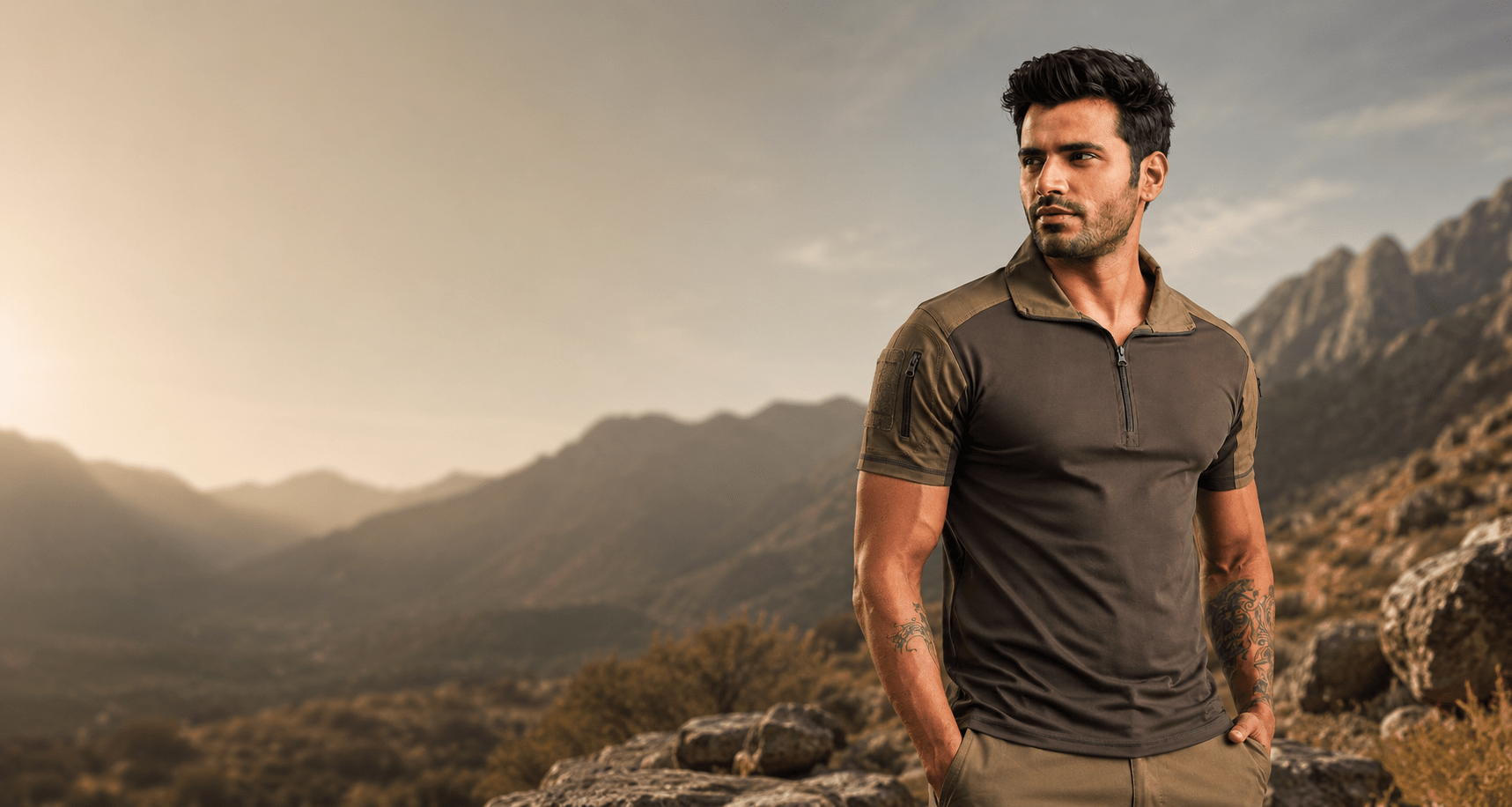
A note on language. "Tactical" in civilian outdoor wear describes a construction philosophy, not a category with hard boundaries. Three things separate a tactical-style tee from a regular athletic or casual cotton tee: fabric designed around movement under load, seam engineering at high-stress zones (raglan sleeves or gusseted underarms with flatlock stitching), and a layered finish stack on the fabric. If you have raised both arms in a fitted gym tee and felt the hem ride up to your ribs, that is the construction problem a tactical tee is built to solve.
The five-decision framework at a glance
The framework runs in order. Decisions one and two are about how and where you wear the shirt. Three and four are about how it fits and what it is made of. Five is the durability of finishes that decide how the shirt feels in month six rather than week one.
| Decision | The question to answer | What it determines |
|---|---|---|
| 1. Primary use | Gym, trekking, motorcycling, daily wear, or travel? | The fabric and sleeve baseline |
| 2. Sleeve length | Half, full, or three-quarter? | UV protection, layering, ventilation |
| 3. Fit profile | Athletic-slim, regular, or oversized? | Movement under load, daily-wear readability |
| 4. Fabric blend | Polyester-elastane, cotton-lycra, tri-blend, or nylon-lycra? | Sweat behaviour, dry time, hand feel |
| 5. Finish stack | Wicking, anti-odor, stretch, UV, DWR, and which are structural? | Performance durability past 30 washes |
The remainder of this guide walks each decision in depth, then maps the framework to specific shirts in the MountMiller tactical t-shirts collection so you can take the framework to a product page and qualify a shirt without guessing.
Decision 1: What is your primary use?
You are buying for the use you will actually live with most weeks, not the trip you take twice a year. Identify the activity that accounts for at least 40% of the shirt's wear and let that anchor the rest of the framework.
Gym and fitness
Sustained sweat output, bilateral movement, indoor air-conditioning or fan-only spaces. The shirt needs to wick fast, recover its shape between sets, and not bunch at the waistband during floor work. A 90/10 polyester-elastane in half sleeve at 160–180 GSM is the structural baseline. Look for explicit four-way stretch if your training mixes pulls, presses, and rotation. The Black Core Raglan Half Sleeves fits this brief, with a raglan sleeve that removes the shoulder seam under overhead load.
Trekking and outdoor activity
Multi-hour exertion, variable shade, pack straps across the shoulders and hip belt across the waist. The shirt has to clear sweat fast, dry between rest stops, and resist UV on exposed stretches. IndiaHikes, one of India's largest trekking organisations, recommends full-sleeve dri-fit with sun coverage as the trekking baseline. For Himalayan and Sahyadri trails, that translates to a full-sleeve polyester-elastane at 160–180 GSM with structural moisture wicking and a UPF-conscious dark colour. The Grey Digital Full Sleeves is built to this spec.
Motorcycling and daily commute
The shirt sits under a riding jacket, against a hot tank, with sleeve fabric rubbing against the inside of jacket cuffs for hours. Full sleeve is non-negotiable for any highway riding, for UV exposure on the forearms and as a first-layer barrier in a low-speed slide. A 160–180 GSM polyester-elastane with articulated sleeves and a long-line rear hem keeps the shirt tucked when you lean forward over the tank. The Arid Full Sleeves Tactical T-Shirt fits this brief.
Daily wear and urban use
Most of the day is indoors with intermittent outdoor walks. Comfort and how the shirt reads as a standalone garment matter more than ventilation extremes. A cotton-lycra blend or a polyester-cotton tri-blend in regular fit is the right starting point. The Black Element Cotton-Lycra Full Sleeves leans this way, with cotton breathability and enough stretch to avoid binding.
Travel and minimal-luggage trips
The shirt has to wash in a hotel sink, dry overnight, and look acceptable through three wears between washes. That points back to polyester-elastane with structural anti-odor. The Beige Armour Cut Half Sleeves packs flat, dries fast, and reads as urban-utility rather than performance gym.
Decision 2: Half, full, or three-quarter sleeve?
Sleeve length is decided by the climate window the shirt is for and how much exposed-skin UV protection you actually need. The default reflex in Indian summer is half sleeve, and for indoor gym use that is correct. For most outdoor and motorcycling use, full sleeve outperforms.
Half sleeve
Maximum airflow and arm mobility. The right choice for indoor gym, fitness sessions under a fan, dense-canopy treks under four hours, and casual daily wear in monsoon and summer. The limitation is UV. Bare arms in direct Indian sun above 11 AM see UV index 8–11 (Very High to Extreme) across most of the year outside Himalayan regions, which is the case for forearm sun-tanning, sun freckles, and longer-term skin damage if your half-sleeve wear is also your motorcycle commute.
Full sleeve
The trekking, motorcycling, and high-UV-environment default. A full-sleeve shirt in 160–180 GSM polyester-elastane in a light, breathable colour is surprisingly bearable in Indian summer because the UV-blocking woven structure prevents radiant heat absorption even if the fabric does not feel cool to the touch. Full sleeve also gives you a clean first-layer base under a textile riding jacket, a fleece on a cold-morning trek start, or an overshirt on a transitional autumn evening.
Three-quarter sleeve
A genuinely useful compromise for Indian spring and autumn transitions when mornings are 14–20°C and afternoons climb to 28–34°C. More forearm coverage than half sleeve, more ventilation than full sleeve. Options are narrower, since the form factor exists more in casual athleisure than tactical-style retail. Practical for post-monsoon commuting or hill-station travel.
The decision tree that resolves most of the sleeve question:
- If the shirt's primary use puts you outdoors between 11 AM and 4 PM more than two days a week, full sleeve.
- If the shirt's primary use is indoor gym or evening outdoor activity, half sleeve.
- If your primary use is post-monsoon transition wear or a hill-station week, three-quarter is worth the harder search.
Decision 3: Fit profile
Indian sizing is not standardised across brands, so always check the brand's chart against your own chest measurement (taken at the widest point with the tape parallel to the floor). Indian tactical-style brands typically run S to XXXL, covering chest 36–46 inches, with regular fit adding 2–4 cm of ease over your exact measurement.
Athletic / slim fit
The cut follows the upper body closely: chest and shoulders fitted, waist slightly tapered. It reads as performance because the fabric does not pool under a pack or gear. In two-way stretch fabric or cotton-spandex, athletic fit binds at the waist when you bend; in four-way stretch polyester-elastane it stays manageable. For a 40-inch chest, athletic fit usually means buying M (38–40) on a typical Indian chart.
Regular fit
The most versatile cut for India because it works under a riding jacket, over a thin base layer, and as a standalone shirt. It does not read as gym-athletic but it also does not restrict movement. For a 40-inch chest, regular fit means buying the L. Most MountMiller tactical t-shirts in the ₹1,000–2,500 band are cut regular, which is the right baseline for mixed outdoor and daily wear.
Oversized / relaxed
Reads as streetwear, billows under riding gear, will not tuck cleanly for gym work. Acceptable for travel and daily wear but a poor fit if the shirt has to cross use cases.
Indian sizing reference
| Tag | Chest (in) | Regular fit suits | Athletic fit suits |
|---|---|---|---|
| S | 36–38 | 34–36 in chest | 36–37 in chest |
| M | 38–40 | 37–39 in chest | 38–39 in chest |
| L | 40–42 | 40–41 in chest | 40–41 in chest |
| XL | 42–44 | 42–43 in chest | 42 in chest |
| XXL | 44–46 | 44–46 in chest | 44 in chest |
If you are between sizes, fabric decides. In four-way stretch polyester-elastane, size down for a closer fit. In cotton-lycra or tri-blend with less stretch, size up to keep movement comfortable.
Decision 4: Fabric blend
Fabric is where buying mistakes get expensive. The label percentage tells you almost everything about how the shirt will behave across a sweat session, a wash cycle, and a year of wear.
Polyester-elastane (the tactical-style default)
A 90/10 to 95/5 polyester-elastane ratio is the most common construction for mid-tier tactical-style tees in India. Polyester provides the structural framework: tensile strength, dimensional stability, and the hydrophobic fibre chemistry that makes moisture wicking possible. Elastane acts as integrated springs. At 90/10 the fabric typically has enough elastane for four-way stretch, accommodating diagonal movement like reaching forward over a motorcycle tank or swinging a trekking pole. At 95/5 you usually get two-way stretch, adequate for gym work but slightly restrictive on torsional movement. Four-way stretch fabrics also recover their shape better over hundreds of wash cycles. If a listing says only "stretch fabric" without specifying direction, assume two-way.
Cotton-lycra (95/5 cotton-spandex)
Breathability and absorptive feel of cotton with just enough stretch to remove binding. This is the most appropriate fabric for Indian summer casual conditions and dry-heat plains because cotton's fibre structure allows static airflow that synthetics do not. The tradeoff is dry time. A cotton-lycra tee worn during a hard uphill trek in humid Sahyadri conditions becomes heavy and will not dry between rest stops, which leads to chafing and bacterial odour. Cotton-lycra is also less UV-resistant than dense polyester. The honest use is low-intensity outdoor activity, summer daily wear, and urban environments where most of the day is indoors or in shade.
Polyester-cotton tri-blend
Tri-blends (typically 50% polyester, 25% cotton, 25% rayon) appear in lifestyle-positioned tees targeting daily wear. Polyester handles wicking and structure, cotton gives the familiar warm-feel breathability, rayon contributes drape. The limitation for hard outdoor use is wet strength: rayon loses 40–50% of its strength when wet, creating vulnerability at the collar and underarm seams under sustained sweat. Tri-blends are good for daily wear and short travel; avoid them for multi-day trekking and heavy gym use. Tri-blends are also rare in tactical-style retail in India.
Nylon-lycra torso with cotton-polyester sleeves
Some Indian manufacturers use a nylon-lycra torso (80/20 or 90/10) with a cotton-polyester sleeve (70/30). Nylon is softer against skin than polyester and has slightly higher abrasion resistance, which helps when the shirt is worn under backpack straps for long hours. The tradeoff is that nylon absorbs slightly more moisture than polyester and dries a little slower under static conditions. The mixed-sleeve construction puts the harder-wearing nylon at the heat-and-friction torso zone and leaves the arm slightly more breathable. The OG Special Forces Adaptive Tactical T-Shirt uses a build of this kind.
What GSM tells you (and what it does not)
GSM is fabric density in grams per square metre. A higher number means a denser fabric, not necessarily a better one. For tactical-style tees in Indian conditions, 160–180 GSM is the functional sweet spot. Below 160 the fabric starts feeling like an undershirt; above 200 GSM in 100% polyester it runs noticeably warm in Indian summer. The widely cited "180–220 GSM is mid-weight performance" guidance applies to temperate climates. In North Indian summer above 38°C and coastal humidity, the lower end performs better.
A note on the same-number-different-fabric trap: 180 GSM in cotton and 180 GSM in polyester feel very different. Cotton feels heavier and more substantial; polyester feels lighter and more airy at the same number because polyester's fibre density per strand is higher.
Decision 5: The finish stack
Finishes are the marketing layer on the spec sheet and the most variable part of long-term performance. Three of the four finishes that matter are structural fibre properties (durable for the garment's life), and the fourth is a surface coating (degrades with washing). Knowing which is which is the difference between a shirt that still performs at wash 50 and a shirt that smells after two hours by month four.
Moisture wicking
In a modern performance fabric, moisture wicking is a structural property of hydrophobic synthetic fibres, not a separate treatment. Polyester absorbs less than 1% of its weight in moisture; sweat sits on the outer fibre surface where it spreads and evaporates. Some shirts add a topical hydrophilic finish on top, the "dri-fit" or "cool-dry" marketing language. To verify on a product page: look for "100% polyester" or "polyester-elastane" as the primary fibre, which alone delivers wicking. "Advanced moisture-wicking technology" with no fibre disclosure usually signals a cotton tee with a topical finish.
Anti-odor and antimicrobial
Odour in performance wear comes from bacteria metabolising sweat residue on the fabric, not sweat itself. There are two grades of antimicrobial finish with very different durability:
- Silver-ion embedded in the fibre during extrusion lasts 50–100+ wash cycles, often described as the garment's functional lifetime. Listings call this "silver-ion antimicrobial," "ionic silver," or use named technologies like HeiQ.
- Topical antimicrobial finish applied after weaving lasts 5–30 washes depending on bond quality. Most performance tees under ₹800 use topical finishes. If the listing says only "antimicrobial" with no specifics, assume topical.
If you wear the shirt heavily and want anti-odor to last, look for silver-ion specifically. For gym use where the shirt is washed after every session anyway, topical anti-odor is acceptable for the first six months.
Four-way stretch
Construction property, not a surface treatment. Arises from a specific knit structure (interlock or tricot) combined with 10–15% elastane content. Two-way stretch uses 5–8% elastane. Four-way stretch accommodates diagonal movement, which matters for reaching forward over a handlebar, swinging a trekking pole, or doing a pull-up. Two-way is fine for linear gym work and standing daily wear.
UV protection (UPF)
UPF is the fabric equivalent of SPF in sunscreen, covering both UVA and UVB. Polyester is inherently UV-resistant due to its molecular fibre structure: dense dark polyester can achieve UPF 50+ without any added treatment, while a white cotton tee typically rates below UPF 10. For motorcycling and trekking in India, UPF 30 minimum is the practical threshold; UPF 50+ is worth paying for if the shirt sits on exposed skin for hours. Open mesh constructions, even in polyester, can fall to UPF 15 because the open structure lets UV through. Most Indian tactical-style brands describe shirts as "UV protective" without a third-party UPF number; treat the language as directional, and choose darker, denser fabrics if UV exposure is a primary concern.
DWR (durable water repellent)
A surface coating that causes water to bead off rather than soaking in. Useful for light rain on a trek or unexpected drizzle on a ride, but it is not waterproofing. DWR is the most fragile of the finishes; even quality outdoor brands define DWR durability at "80% efficiency after 20 washes." Heat reactivates residual DWR after washing. Very few Indian tactical tees under ₹2,500 explicitly claim DWR; when it does appear, the shirt sits in the upper-mid tier.
Use-case to product mapping
The framework cleanly maps to specific shirts. Use this as a starting shelf rather than a final answer, then check the product page for the specifics that matter to you.
| Primary use | Sleeve | Fit | Fabric direction | MountMiller lead pick |
|---|---|---|---|---|
| Gym and fitness | Half | Athletic-slim | 90/10 polyester-elastane, four-way stretch | Black Core Raglan Half Sleeves |
| Trekking, Himalayan and Sahyadri | Full | Regular | Polyester-elastane, structural wicking, UPF | Grey Digital Full Sleeves |
| Motorcycling, all seasons | Full | Regular | Polyester-elastane, articulated sleeves | Arid Full Sleeves Tactical T-Shirt |
| Daily urban wear | Full | Regular | Cotton-lycra, light stretch | Black Element Cotton-Lycra Full Sleeves |
| Travel, multi-day | Half | Regular | Polyester-elastane, anti-odor | Beige Armour Cut Half Sleeves |
| Mixed outdoor and daily | Full | Regular | Nylon-lycra torso, polyester-cotton sleeves | OG Special Forces Adaptive |
Answer the five framework questions for your week and the table gets you within two clicks of the right shirt.
Pricing tiers in Indian retail (INR, mid-2026)
Pricing maps to construction. The right tier depends on how the shirt is used and how often it cycles through the wash.
Entry (₹300–800). Marketplace dri-fit tees, Decathlon's lower lines. Typically 100% polyester at 160–180 GSM, two-way stretch, topical wicking and topical anti-odor. Finishes degrade after 15–25 washes. No raglan, no gusset, standard set-in sleeve. Good for occasional gym or short outdoor use; not the right tier if the shirt will be worn three or four days a week.
Mid-range (₹800–2,000). Wildcraft, CliffClimbers, MountMiller half-sleeve, The Adventure Hut. More deliberate cut for outdoor use, frequent mesh ventilation panels, partial UPF claims, some models using raglan construction (MountMiller's OG Core Raglan Half Sleeve is explicit). Domestic sizing fits Indian chest measurements. This is the right starting tier for most first-time tactical t-shirt buyers in India.
Upper-mid (₹2,000–4,000). MountMiller full-sleeve tactical, CliffClimbers full-sleeve, nylon-lycra torso shirts from domestic manufacturers, AeroFlex tactical shirts. Higher confidence in fabric specs, explicit stretch-direction claims, seam reinforcement, fuller product documentation. MountMiller's Black Multicam Half Sleeves sits in this band.
Premium (₹4,000–8,000+). Imported tech tees through Decathlon, niche DTC outdoor, Special Forces Adaptive shirts with nylon-spandex torso and UV fabric. Verified UPF rating, longer-lasting anti-odor, articulated patterns. Worth it if you wear the shirt four or more days a week and want it intact after two years.
Brand-direct from a domestic D2C typically matches or undercuts Amazon and Flipkart listings, and the product pages carry more detailed spec disclosure than marketplace listings.
Three mistakes first-time tactical-tee buyers make in India
Buying for the rare-use case rather than the weekly use. A shirt purchased for an annual Himalayan trek but worn 320 days a year for gym and commute is the wrong shirt. Buy the gym-and-commute shirt first; the trek-specific full-sleeve UPF shirt is the second purchase.
Trusting "tactical" branding without checking the spec sheet. Tactical is a marketing adjective used on everything from ₹275 marketplace tees to ₹4,500 specialist shirts. The word has no regulatory definition in apparel. Evaluate on fabric composition percentage, GSM, finish specifics (silver-ion versus topical), and construction features (raglan, gusset, flatlock), not the label.
Treating higher GSM as automatically better. In cotton, higher GSM reads as more premium. In performance synthetic, higher GSM without mesh or ventilation engineering means more thermal mass, so the shirt runs hotter. A 160 GSM well-engineered polyester tee outperforms a 240 GSM poorly constructed one in hot Indian conditions.
How to read a product page in 90 seconds
Take the framework to a listing and check, in order:
- Fabric composition by percentage. Polyester-elastane 90/10 or 95/5 for performance use; cotton-lycra 95/5 for daily wear; nylon-lycra torso with cotton-polyester sleeve for crossover use. If the listing shows no percentages, treat the spec as unverified.
- GSM. 160–180 for outdoor performance in Indian conditions; 180–200 for daily wear that has to hold structure.
- Stretch direction. "Four-way stretch" stated explicitly. If only "stretch fabric" is mentioned, assume two-way.
- Sleeve construction. Raglan, gusseted underarm, or articulated sleeve mentioned in the spec. Standard set-in sleeve is acceptable for gym use; for trekking and motorcycling, look for one of the three reinforced constructions.
- Anti-odor specifics. Silver-ion or named technology versus generic "antimicrobial finish." The first lasts the garment's life; the second fades after 10–30 washes.
- Care instructions. Cold-water wash, no fabric softener, low-heat dry. If the care label is missing or hidden, treat it as a flag.
Care that protects your investment
A tactical-style tee at the mid or upper-mid tier represents real money; care decides how long it performs:
- Wash cold (maximum 30°C). Warm water binds odour compounds into polyester and accelerates fibre degradation by roughly 4x over 20 washes.
- Use enzyme-based detergents; they break down sweat proteins better than standard detergents.
- Never use fabric softener. It clogs the engineered wicking channels and is the single most common reason anti-odor performance degrades fast.
- Air-dry flat or hanging in indirect light. If you must machine dry, use the lowest heat setting for under 20 minutes and finish on a line.
- Bleach destroys elastane and strips antimicrobial finishes within a single wash. Skip it entirely.
A 160–180 GSM polyester-elastane tee cared for properly holds wicking, silver-ion anti-odor, and stretch performance for 50+ washes. Cared for badly, the same shirt is functionally a cotton tee by month four.
Frequently asked questions about tactical-style t-shirts
Is a polyester tactical t-shirt actually cooler than cotton in Indian summer?
It depends on the activity. In static dry-heat conditions, like standing on a Delhi platform, cotton's natural airflow is more comfortable than basic polyester. Once you generate body heat through uphill trekking, a gym session, or riding at highway speed, the comparison flips. Polyester absorbs less than 1% of its weight in moisture and dries in 1–2 hours, while cotton absorbs up to 27% and dries in 4–6 hours. For sustained movement and sweat, a well-engineered polyester-elastane tee outperforms cotton on every comfort metric except static breeze.
How do I know whether a shirt's anti-odor will last beyond a few months?
Look at the language on the product page. Silver-ion antimicrobial, ionic silver, or named technologies like HeiQ are fibre-embedded during extrusion and last 50 to 100+ wash cycles. Topical antimicrobial finish applied after the fabric is knitted lasts 5 to 30 washes depending on the chemical bonding. Most performance tees under ₹800 use topical, most premium tactical tees above ₹2,000 use silver-ion. If the listing says only "antimicrobial" without a named technology, assume topical and expect noticeable decline by wash 25.
Can I wear a full-sleeve tactical tee in Indian summer without overheating?
In a 160–180 GSM polyester-elastane in a light or medium tone with structural moisture wicking, yes, surprisingly comfortably. The UV-blocking woven structure prevents radiant heat absorption even when the fabric does not feel cool to the touch, and the wicking moves sweat off your skin faster than a half-sleeve cotton tee in the same heat. The shirts that overheat in summer are dense 100% polyester at 220+ GSM without ventilation engineering, or any cotton-spandex in fully exposed sun. Pick the fabric and GSM right and full sleeve is bearable across Indian summer.
How does Indian sizing compare to international tactical brands?
Indian domestic tactical brands typically cut closer to actual Indian chest measurements, while international brands cut to US or EU charts which run larger across the chest and longer in the torso. For a 40-inch chest, regular fit in an Indian brand is usually L; the same buyer in an international brand often takes M. Always measure your chest at the widest point and cross-reference the brand's specific chart rather than assuming the size tag carries the same meaning across brands.
Building your tactical-style t-shirt rotation
The framework works best when you stop thinking about one shirt and start thinking about a small rotation built around your week. For most Indian buyers a three-shirt rotation covers 90% of use: a half-sleeve polyester-elastane for gym and indoor activity, a full-sleeve polyester-elastane for trekking and motorcycling, and a cotton-lycra full-sleeve for daily wear and lower-intensity outdoor time. Add a fourth shirt for travel, a polyester-elastane with strong anti-odor that carries three wears between washes, and the rotation handles most weeks without a use case underserved.
The MountMiller tactical t-shirts collection is built around exactly this logic. Each shirt is positioned against a specific use slot, with the fabric, sleeve, and finish stack matched to that use rather than a generic tactical aesthetic. The framework above gives you the questions to ask; the collection gives you the answers, mapped to specific shirts with Indian sizing, INR pricing, and disclosure on the construction details that matter.
If your week is mostly gym with occasional outdoor weekends, start with a half-sleeve polyester-elastane in the mid tier and add the full-sleeve once the rotation is bedded in. If your week is mostly motorcycling and outdoor with gym secondary, start with the full-sleeve. Either way, you are buying for the use you actually live with, which is the only buying decision in tactical apparel that ever pays back.


Comments
Leave a comment
Your email address will not be published. Required fields are marked *
No comments yet. Be the first to share your thoughts!