


Cart
0

Blog Article
Tactical Pants vs. Cargo Pants: Are They the Same?
Tactical Pants vs. Cargo Pants: Are They the Same?
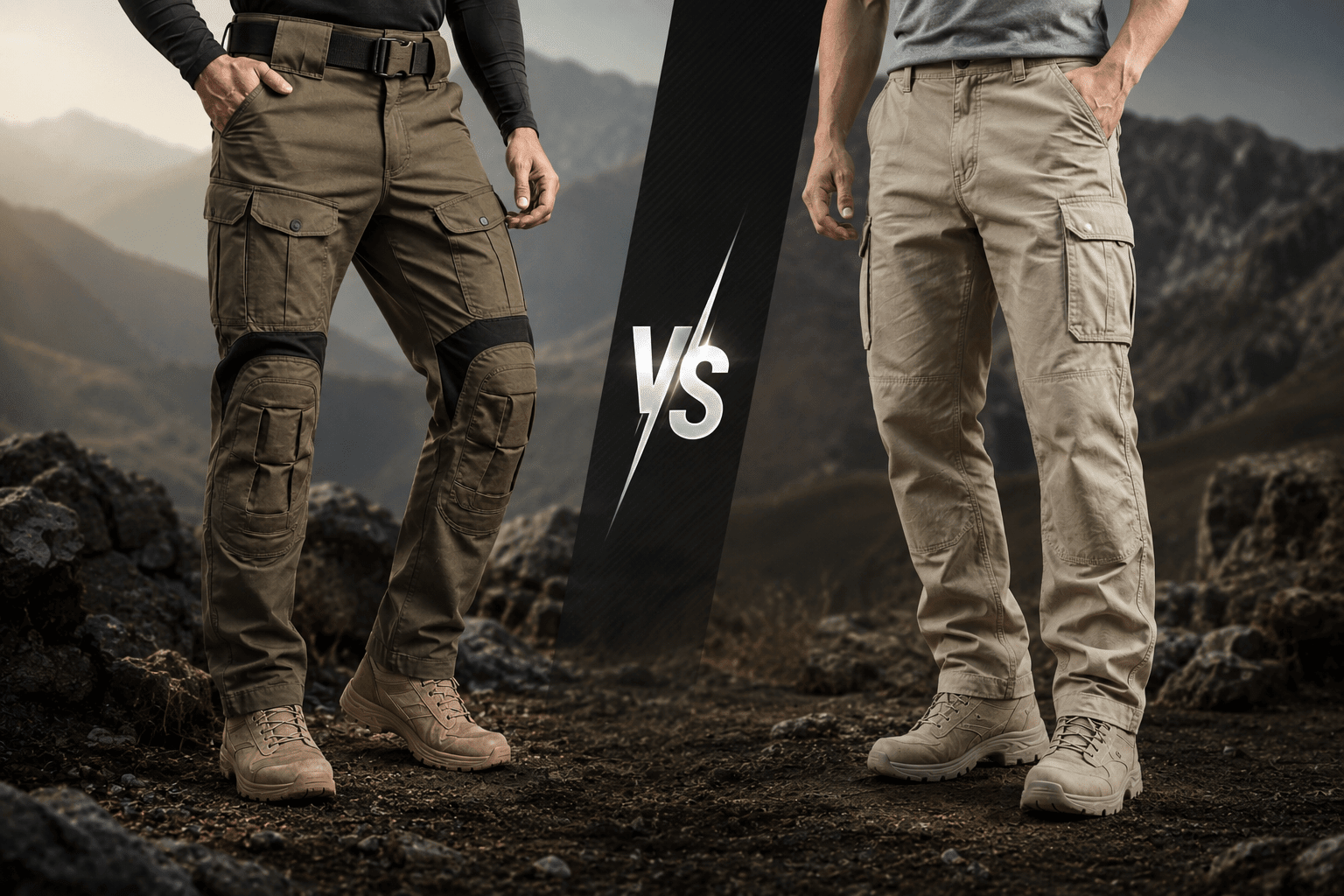
Stand two pairs of pants side by side on a Myntra or Amazon India listing page, one labelled "cargo" and the other "tactical", and most Indian buyers cannot tell them apart. Both have thigh pockets, reinforced knees, a synthetic-looking fabric, and a confident name. They are not the same garment. A cargo pant is a relaxed-cut trouser built around large utility pockets and casual movement. A tactical-style pant is a cargo pant with a specific cluster of construction upgrades layered in: articulated knees, a gusseted crotch, bar-tacked stress points, ripstop weave, and slimmer secure-closure pockets. The label is a starting point. The construction is what you actually wear. The MountMiller OG Ripstop is the cleanest reference point for tactical construction in Indian retail at a mid-tier price.
What is a cargo pant, exactly?
Cargo pants are loose-cut trousers defined by their large utility pockets, typically bellowed or expandable patch pockets on the outer thigh, secured with a flap and button, snap, or Velcro closure. The style traces to British military workwear of the 1940s, migrated through outdoor and construction workwear, and embedded itself in mainstream fashion from the late 1990s onward. The minimum pocket count that earns the cargo name is typically six: two front hand pockets, two rear pockets, and two thigh cargo pockets, though seven- and eight-pocket layouts are common.
Fabric has historically been cotton or cotton canvas, valued for hand feel and abrasion resistance. The modern Indian market widely uses cotton-polyester blends and technical synthetics for lighter versions: 65% cotton/35% polyester for travel-oriented cargo, 97% cotton with 3% spandex for fashion-leaning models, and 94% polyamide with 6% elastane for lightweight outdoor cargo. The cut is relaxed for freedom of movement at the knees and hips, and seams are usually felled, where the raw edge is enclosed within the seam allowance for added strength. Cargo pants do not, by default, include articulated knees, a gusseted crotch, or ripstop weave. Some outdoor-leaning cargo pants from Wildcraft, Decathlon, and MountMiller do, which is where the boundary blurs.
What is a tactical pant, exactly?
A tactical pant in civilian Indian retail is a cargo pant with a specific set of construction upgrades that make it more capable for sustained outdoor and high-movement use. According to Wikipedia, tactical pants are closely related to cargo pants but typically solid in colour and were originally worn by mountain climbers as more durable outdoor apparel before the category expanded into broader civilian use.
The defining structural cluster that distinguishes a purpose-built tactical pant from a standard cargo pant is six features working together:

- Articulated (pre-shaped) knees: darts or a shaped panel sewn into the front knee so the pant sits in a slightly bent position at rest, allowing deep squats and long-stride movement without the fabric pulling taut
- Gusseted crotch: a diamond- or triangular-shaped extra panel sewn into the crotch seam, distributing the four-way seam stress across a wider area to prevent tears and enable deep squats
- Bar-tacking at every high-stress point: short, dense zigzag stitches at every pocket corner, belt loop base, fly bottom, and knee pad insertion point, rather than ordinary double-needle topstitching
- Knee pad-ready pockets: internal sleeves behind the outer knee panel that accept soft insert knee pads
- Slim-profile pockets with secure zip or hook-and-loop closures rather than bellowed flap-only cargo pockets
- Ripstop weave fabric, usually with synthetic fibre content, where reinforcing threads stop tears from propagating
If a pant has all six, the tactical label is honest. If it has two or three, it sits somewhere between a cargo pant and a tactical pant, and the label is half-marketing. The MountMiller OG Ripstop carries the full construction cluster at the ₹2,499 tier, and the OG Achiever variant sits alongside it for buyers who want the same construction in a different cut and colourway.
Quick comparison: cargo vs. tactical at a glance
The fastest way to read the categories is across the construction details, not the name. This table treats the cargo pant as the reference point.
| Feature | Standard Cargo Pant | Tactical-Style Pant |
|---|---|---|
| Typical pocket count | 6 to 8 | 8 to 10 |
| Thigh pocket type | Large bellowed patch, flap closure | Slimmer, multi-compartment, zip or Velcro |
| Fabric weave | Plain weave, sometimes ripstop | Ripstop standard |
| Fibre blend (Indian retail) | 65/35 cotton-poly, 97% cotton, or 94% polyamide | 70/30 cotton-poly or 65/35 poly-cotton, often with 2 to 5% spandex |
| Articulated knees | Rare except in outdoor sub-category | Standard |
| Gusseted crotch | Rare | Standard |
| Bar-tacking at stress points | Inconsistent | Standard |
| Knee pad sleeve | None | Common at mid-tier and above |
| Closure quality | Generic snaps and zippers at budget tier | YKK zippers, Prym snaps at branded tier |
| Best for | Casual urban wear, light travel, errands | Trekking, biking, camping, outdoor work, daily utility |
| Indian price band | ₹400 to ₹2,500 | ₹1,800 to ₹5,000 |
MountMiller occupies the right column at the mid-tier price, alongside Cliff Climbers and DeltaTac. International brands such as 5.11 Tactical sit in a higher import-pricing bracket without an official India storefront, with grey-imported pieces landing at significant premiums over US retail.
Fabric: where most of the difference lives
Fabric choice drives most of what separates a working tactical pant from a working cargo pant. The headline number is GSM, grams per square metre, which measures how much a square metre of the fabric weighs. GSM is not the only durability indicator; a 155 GSM ripstop fabric can outlast a 200 GSM plain-weave cotton because the ripstop grid stops tears from propagating regardless of overall weight. For trousers specifically, 150 to 175 GSM is lightweight and hot-weather appropriate, 190 to 220 GSM is the standard workwear and outdoor range, and 240 to 280 GSM is heavy-duty utility territory.

A standard Indian cargo pant in 97% cotton or 65/35 cotton-poly canvas sits at 200 to 280 GSM. It is soft, slow to dry, and warm in monsoon. A lightweight outdoor cargo like the Decathlon SG-500 is listed at 157 GSM in 94% polyamide with 6% elastane, breathable and quick-drying, but with less abrasion resistance than the heavier blends. Tactical pants typically use ripstop weave in cotton-poly or poly-cotton blends. The 70/30 cotton-poly ripstop popular in domestic Indian tactical brands handles Indian heat better than the 65/35 poly-cotton international standard while keeping the ripstop tear resistance. Premium variants add 2 to 5% Lycra or spandex, or use a mechanical-stretch weave, for 4-way movement. The MountMiller Woodland Advanced WR ripstop layers a water-repellent finish over the ripstop base, which is the practical wet-weather addition for monsoon use.
Stretch is the second axis. Plain cotton cargo pants have no stretch and accommodate movement through extra fabric volume. Cotton-poly ripstop tactical pants have limited inherent stretch; articulated knees and the crotch gusset compensate. Poly-nylon with 2 to 5% elastane delivers 2-way stretch. Poly-nylon with Lycra or mechanical stretch gives 4-way stretch, found in premium tactical pants and outdoor cargo alike. For Indian buyers riding bikes daily or trekking in summer, the 4-way stretch tier is the most comfortable.
Construction: pockets, knees, gusset, and bar-tacks
A common misconception is that tactical pants always have more pockets than cargo pants. In practice, pocket count is not a reliable differentiator. What differs is pocket type and position. Cargo pants typically have six to eight pockets dominated by two large bellowed patches on the thighs. Tactical pants typically have eight to ten with slimmer, multi-compartment thigh pockets, secure closures, and specialty slots for small tools, a phone, a compass, or a headtorch. The MountMiller OG Ripstop lists ten pockets total, while a Bewakoof or Flipkart budget cargo lists six.
Reinforcement at the knees is the second visible difference. Entry-level cargo pants may have double-stitched seams at the seat but typically lack dedicated knee reinforcement. Outdoor cargo and tactical pants share double-reinforced seats and knees. The specific tactical feature is a sleeve behind the knee panel for insertable knee pads. Without the sleeve, any reinforcement layer is fixed and adds weight. With the sleeve, the pant is lighter and the pad becomes optional, which is useful for camping, photography on rocky ground, or any work that involves kneeling.
The crotch gusset is where tactical construction earns its reputation. A standard trouser joins the front seam, inseam, and back seam at a single point, concentrating all stress there. A gusseted crotch adds a diamond or triangular panel that spreads the stress across a wider area. The practical effect: you can step over a gate, squat to pick something up, or sit cross-legged on a rock without feeling seam strain or hearing stitching pop. For motorcycling specifically, where the seated position stretches the crotch seam for hours, a gusseted crotch is a meaningful comfort difference. The 5.11 Taclite Pro specifies a fully gusseted crotch as a key feature; so does the MountMiller OG line.
Bar-tacks are the quiet quality indicator. They are short, dense zigzag stitches applied at high tension at pocket corners, belt loop bases, and other stress concentrations. On a finished garment they look like a small rectangular block of dense thread. Their presence at pocket corners, where pockets fail first from weight-bearing, is the quickest visual quality check at the listing stage. Branded tactical pants will list a bar-tack count or call out the practice; standard cargo pants rarely do.
Pricing in INR: what each tier delivers
Indian retail spans a wide range across both categories. The bands below assume current 2026 listing prices and are directional rather than fixed.
| Tier | Price Range (INR) | What You Typically Get |
|---|---|---|
| Budget cargo | ₹400 to ₹999 | Cotton or poly blend, 6 pockets, flap closure, no ripstop, no articulation; brands like Bewakoof and Flipkart house labels |
| Budget tactical | ₹800 to ₹1,500 | Often plain-weave with minimal construction upgrades; treat the label with scepticism and check the spec sheet |
| Mid-range cargo | ₹1,500 to ₹2,500 | Cotton-poly or nylon-elastane, quick-dry, zip pockets, 6 to 8 pockets; Decathlon Travel 100 and Wildcraft sit here |
| Mid-range tactical | ₹1,800 to ₹3,500 | Ripstop weave, articulated knees, gusset, bar-tacking; MountMiller OG at ₹2,499 is the reference point |
| Premium domestic tactical | ₹3,500 to ₹6,000 | Full construction package, YKK zippers, 4-way stretch, water-repellent finish; MountMiller Advanced variants |
| Imported international | ₹6,500 to ₹20,000+ | 5.11 and Blackhawk through third-party importers on Amazon India, with limited official India presence |
The MountMiller tactical pants collection covers the mid-range and premium domestic bands across solid and camo colourways, and represents the most accessible spec-honest entry point in the category for Indian buyers.
Use case: trekking, biking, travel, and daily wear
The category label matters less than the use case. Different jobs reward different features, and either a well-built cargo or a tactical pant can do most of what an Indian buyer asks of an outdoor trouser. The recommendations below are organised by use.

Trekking and hiking
For sustained outdoor movement, whether a multi-day Himalayan trek, a Western Ghats day hike, or a wildlife safari, the construction features that matter are articulated knees, a gusseted crotch, quick-dry synthetic fabric, and a DWR coating. Lightweight outdoor cargo pants like the Decathlon SG-500 or JAG TerraTrek match tactical pants in these features while using the cargo label, and they perform adequately on shorter routes. For longer or more demanding trekking, the MountMiller line includes a dedicated trekking variant: the Woodland Trekking Ripstop carries the ripstop tactical construction in a fit and weight tuned for trail use. At the same price, a MountMiller tactical pant and a Decathlon outdoor cargo will both serve a 3-to-5-day Himalayan trek adequately, with MountMiller offering more pocket organisation and Decathlon offering slightly lighter fabric.
Motorcycling
Neither standard tactical pants nor cargo pants, in the absence of CE-rated armour, are motorcycle riding trousers, and they provide no certified abrasion protection in a slide. This is an important distinction. Dedicated motorcycle riding pants are a separate category with CE Level 1 or Level 2 knee and hip armour inserts. Within the non-armoured category, however, tactical pants with a gusseted crotch and 4-way stretch significantly improve riding comfort over plain cargo pants, because the seated riding position stretches the crotch seam for hours. The MountMiller Multicam Advanced Ripstop is a popular pick among Indian commuter bikers for this reason: 70/30 cotton-poly ripstop, stretch panels at the knees, and a ten-pocket layout that distributes phone, wallet, keys, and tools across the body instead of into a bag. For daily commuting and weekend rides where CE gear is worn separately or not at all, a heavier ripstop tactical pant is the most comfortable non-armoured option.
Travel
For Indian travel conditions, heat above 38 degrees Celsius, monsoon rain, crowded transport, varied terrain, the practical differentiators are quick-dry fabric, zip-secured pockets, and lightweight construction. Both good cargo pants and good tactical pants deliver these. Tactical-specific features like knee pads and magazine pockets add weight and visual profile without adding travel benefit, so a slim-cut, solid-colour tactical pant or a stretch outdoor cargo at the mid-tier is the most practical pick. The MountMiller line offers dark, neutral colourways that read as ordinary trousers in airport and city contexts while keeping the ripstop and gusset construction.
Daily urban wear
For daily city wear, the calculus shifts. Heavy ripstop tactical pants with external Velcro closures and visible cargo flaps read as outdoor-utility in a formal or business-casual context. Slim-cut tactical pants in solid colours, or quality cotton cargo pants in olive, khaki, or black, are more appropriate. The MountMiller Forest Olive Trekking Ripstop sits at this crossover point: a tactical-construction pant cut and coloured for daily wear, comfortable enough for an office commute and capable enough for an unexpected weekend trail.
How to pick your next pair
The honest answer for most Indian buyers is to choose by your most frequent use, not your most aspirational one. A pant bought for an annual trek but worn 350 days a year in the city is the wrong pant. A pant bought for daily wear but pressed into a serious Himalayan itinerary is the more uncomfortable version of the wrong pant.
If your week mixes office or college, a daily commute, errands, weekend outings, and occasional outdoor activity, a mid-tier tactical pant with the full construction cluster is the most versatile single pant in the category. It will read as a cargo pant in casual settings, perform as a tactical pant when the day turns active, and survive the wash cycle longer than budget cotton cargo. The MountMiller OG Achiever tactical pant is the reference pick at the mid-tier price: 70/30 cotton-poly ripstop with a water-repellent finish, articulated knees, gusseted crotch, bar-tacked stress points, ten pockets, and YKK closures, in a solid colour palette that holds up across both trail and street use.
If your needs lean toward casual urban wear and light travel, a quality cotton cargo at the ₹1,500 to ₹2,500 band serves better. If your needs lean toward outdoor trekking or daily biking, the tactical construction cluster earns its premium. Either way, check the spec sheet for ripstop, gusset, articulation, and bar-tacking before checking the label, and verify inseam length if you are above 5 feet 10 inches, where Indian-standard 34-inch inseams can read short.
Frequently asked questions about cargo and tactical pants
Are cargo pants and tactical pants the same thing?
Cargo pants and tactical pants are closely related but not the same. Cargo pants are loose-cut trousers with large utility pockets, typically six to eight in a relaxed fit. Tactical-style pants are cargo pants with a specific construction cluster: articulated knees, gusseted crotch, bar-tacked stress points, ripstop weave, and slim secure-closure pockets. The tactical label is not regulated in Indian retail, so the construction cluster matters more than the name.
Can I wear tactical pants for daily city wear in India?
Yes, with the right cut and colour. Heavy ripstop tactical pants with external Velcro and large flap pockets read as outdoor-utility in formal contexts. Slim-cut tactical pants in solid neutrals like olive, khaki, charcoal, or black pass casual scrutiny in most Indian urban settings. The pocket utility for phone, wallet, keys, and earphones is a real daily advantage. Skip camo prints if office acceptability matters.
Are tactical pants safer for motorcycling than cargo pants?
Neither tactical pants nor cargo pants provide certified motorcycle abrasion protection without CE-rated armour. Dedicated riding pants are a separate category and remain the safest choice for crash protection. Ripstop tactical pants with a gusseted crotch and stretch panels are noticeably more comfortable than plain cotton cargo for daily commuting and short rides, because the riding posture stretches the crotch seam continuously. At highway speeds, neither category protects.
What should I check on the spec sheet before buying a tactical pant in India?
Six items decide whether a pant labelled tactical actually delivers tactical construction: ripstop weave (visible grid pattern on the fabric), a fibre blend with cotton-poly ratios specified, articulated knees, a gusseted crotch, bar-tacking at pocket corners and belt loops, and YKK or comparable branded zippers. If the listing names none of these and only shows pocket count and waist size, treat it as a cargo pant with the tactical label added.


Comments
Leave a comment
Your email address will not be published. Required fields are marked *
No comments yet. Be the first to share your thoughts!